Owners introduced a new franchise of America’s-, and probably the world’s most popular fast food chain in Hawthorne on August 30th, this year. Lucky residents of the Ingledale Acres Tract (more popularly, the “Ramona Tract”) now have the full menu of McDonald’s within easy reach at 13324 S. Inglewood Ave – at most, just a few blocks away. Since easy access by automobile has always been an important part of McDonald’s business plan, it is certain that residents and visitors throughout our City will be headed to the new outlet for that tasty, classic sandwich that is as much a part of American cuisine as, well, . . . apple pie.
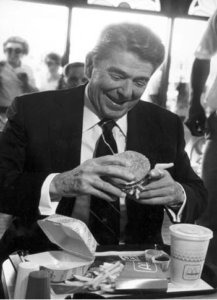
A few years ago, we noted that the origins of the hamburger – even its association with the venerable German seaport – are still a matter of continuing debate. By the 1890s, we Americans had transformed it into an East Coast workers’ lunch wagon favorite and by 1904, it was a big hit at the St. Louis World’s Fair {Louisiana Purchase Exposition} with word about it spreading nationwide. Marrying it to pommes frites (French fries) and milkshakes was an inevitable consequence of our “melting pot” culture.
The history of McDonald’s is so familiar a part of American folklore that school children can probably recite it at intermural quiz competitions. Holding ourselves to a humbler standard, let’s recall some of the events that made a drive-in into a multinational mega corporation:
1937 – The McDonald family operated an orange juice stand on Route 66 in Monrovia, CA (see our May 20, 2025 newsletter).
1940 – Brothers Richard and Maurice opened a drive-in with carhop service in San Bernardino, featuring menu items based on barbecue.
1948 – They switched to emphasis on hamburgers, which had proved to be their most popular item and dropped the carhop- for window service.
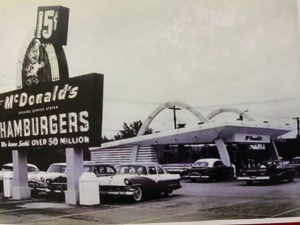
1952 – With the help of an architect, they designed a time-optimized layout for a new building format. It would speed preparation and service of the food and subtly influence customers to “take out” or eat and leave. It standardized a powerful business identity with red and white tile and the first “Golden Arches.”
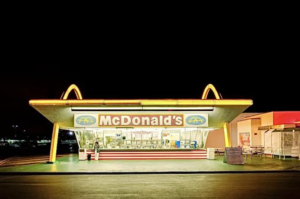
1953 – They sold their first franchise to a buyer in Phoenix, AZ — the first outlet to use the Arches and the McDonald’s name. They sold their second franchise in Downey, CA – now, the oldest “Arches” still standing – because it preceded . . .
1954 – Ray Kroc, who sold milkshake machines and had developed wide experience of the nascent fast food industry. He became interested in the McDonald brothers’ operation and visited. He recommended that they develop a nationwide franchising operation. The brothers were skeptical, wanting to maintain personal oversight of the franchises they sold. They accepted Kroc’s offer to run a program of franchise sales beyond their area of management in California and Arizona. He would keep the rights to the franchises he sold.
1956 – Ray Kroc partnered with Harry J. Sonneborn, former finance vice president of Tastee-Freez, to create the plan for McDonald’s to buy the property and provide the mortgage for construction of the building at each outlet. These costs were recovered (with a mark-up) from installment payments the operators made to purchase the franchise. It allowed the buyer to start a business with an manageable down payment.
1960 – A period of rapid growth followed, aided by the National Interstate and Defense Highways Act of 1956. The Act spurred the construction of Interstate Highways throughout the nation, and our Freeways. The federally-funded “superhighways” provided countless sites where hungry travelers were certain to exit at the sight of a McDonald’s sign.
1961 – The McDonald brothers were uncomfortable with this wild growth and were concerned about quality control of the products and service that bore their name. They disputed the future of the company with Kroc. He responded by asking them to name their price to buy out their interest in the business. They said $2.7 million, a staggering figure in 1961 dollars. Even with the profits from selling the franchises, Kroc didn’t have the money. Sonneborn managed to raise the additional capital and the McDonald’s passed their interest in the business to Kroc and Sonneborn, who were looking ahead to an Initial Public Offering to incorporate the firm.
1967 – Harry Sonneborn resigned from the corporation over an expansion dispute, while in the ‘60s, that expansion was introducing McDonald’s into most of the well-populated communities in the country. Clever merchandising and advertising were transforming the business into an iconic American symbol. There were the tall signs that marked the locations and proudly announced the ever-increasing number of hamburgers sold – in millions, then billions. They added the constant parade of uniquely named and branded menu items that were introduced to instant success: the Filet-O-Fish sandwich, 1962; the Big Mac, 1967 – and so many more. The cast of McDonaldland characters – devised to attract youngsters in advertising, packaging, giveaways and ultimately McDonald’s PlayPlaces – was inviting families to spend more of their dining budget at the franchises. McDonald’s was on its way to taking over the world.
Hawthorne was a ready market for the corporation. While we can’t document the opening date of our first McDonald’s at 4160 W. El Segundo Blvd, there is general agreement that it was during this period. We can confirm that both our El Segundo Blvd store and its equally popular sister at 15606 S. Hawthorne Blvd in Lawndale have served our citizens for more than fifty years. Another franchise appeared at 5310 W. Rosecrans Ave, probably in the ‘80s, as the Rosecrans/Hindry commercial wedge (between the I-405 and the A.T.& S.F. {BNSF?} tracks) was being developed. A store at 11330 Hawthorne Blvd opened in Inglewood, perhaps in the 90’s, as the area was transformed for the passage of Interstate 105.
Our latest McDonald’s joins a multitude of franchises in Southern California that have served us for decades. They are familiar, “Speedee” and easy. Sometimes, that’s the way we like it.