

“It’s The Great Pumpkin!”
Why isn’t there any pumpkin in pumpkin spice-everything? Is it lingering European frustration for not getting the treasures that Columbus set out to bring back from the fabled Orient: cinnamon, cloves, ginger and nutmeg? Why reject the hearty, earthy, sweet flavor of baked pumpkin – the American fruit (technically, a “berry”) that lay at his feet when he ran onto unexpected continents on his way to the Far East?

Yes, the fruit and spices make a great combination for a king’s table, a Pilgrim’s banquet or a traditional holiday dessert, but the pumpkin deserves wider recognition in world cuisine – it’s one of the many gifts of the Western Hemisphere to the people of Earth. The plant family Cucurbitaceae, which includes pumpkins, squash, melons and gourds, is native to North- and South America. There are at least two members (unfortunately, inedible) that are native to the South Bay.
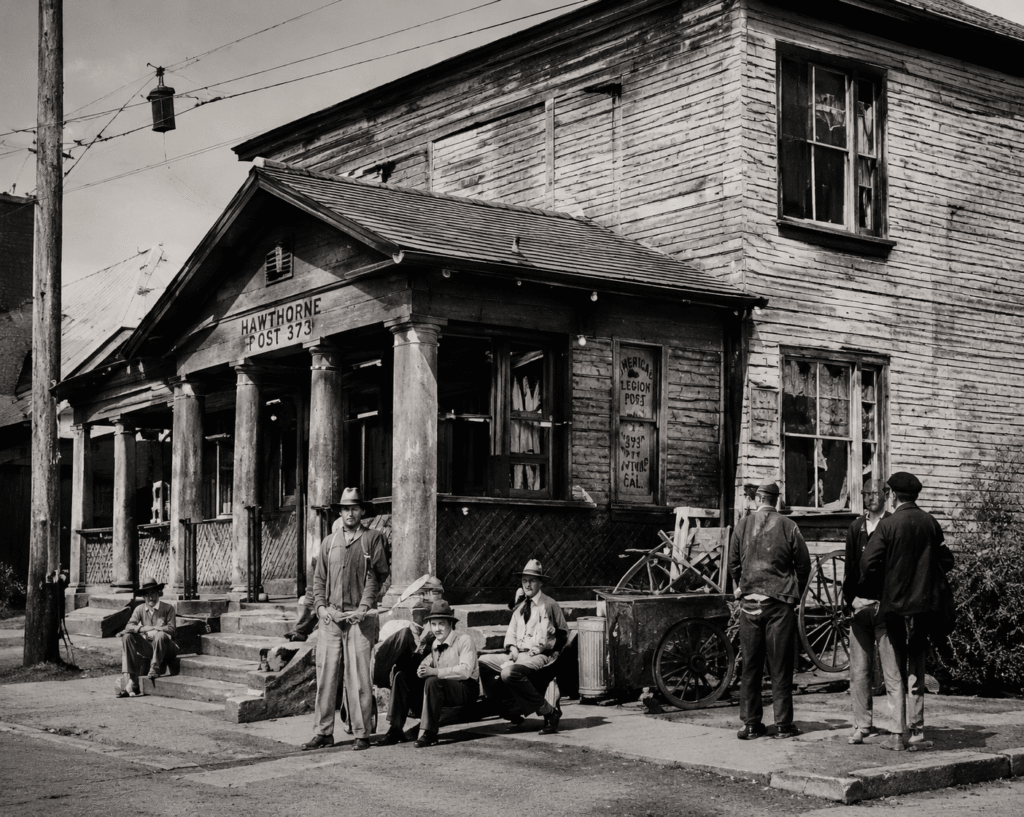
The generations since Columbus have adopted the pumpkin as the ideal armament to frighten away evil spirits and malevolent ghosts abroad on the night before All Saints’ Day. They have bred the pumpkin into every handsome, weird and tasty form to adorn their homes and fill their plates in celebration of the harvest season. Pumpkins will grow readily in the gardens of Hawthorne. The vines and fruit will grow prodigiously in the care of enthusiasts. On September 28th, Jim Sherwood of Mulino, OR, entered a monster named “Hank the Tank” in the 2024 National Pumpkin Weigh Off at Wheatland, CA, that weighed a winning 2,453 pounds – the equivalent of a husky rhinoceros, hippo or bison.

It’s that time of the year when we should think about giving the pumpkin its due: pumpkin ravioli, pumpkin squash soup, pumpkin mac and cheese, pumpkin beef and black bean chili, smokey pumpkin deviled eggs – it’s a great and versatile American native!
Money to Burn
When the sparse La Niña rains finally come this winter, they will lessen the chance of another apocalyptic fire that has been the signature of our persistent period of drought here on the West Coast.
Realistically, fire is a fundamental element of our environment in Southern California. Long before humans wandered in, it shaped the ecosystems – and look – of the South Bay by suppressing the growth of trees in the local plant communities. And where humans went, fire went with them as their companion, but not always their servant. When Juan Cabrillo anchored his fleet in San Pedro Bay in 1542, we can only wonder what form of fire prompted him to name the bight “the Bay of Smokes.”
Right up into modern times, people were accustomed to seeing fire and smoke occasionally run across the prairie and scrublands, up the canyons and hillsides and over the ridges, consuming whatever they had foolishly built in its way. They could fight it, but they couldn’t defeat it. It was a part of life.
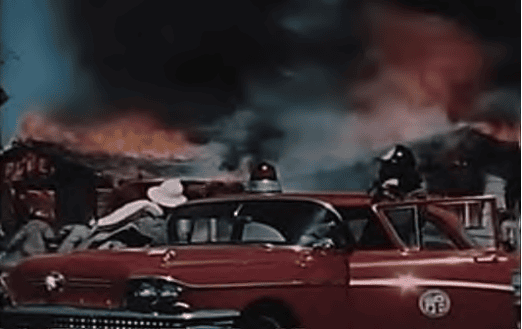
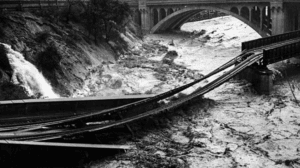
Nothing brought this fact to the general consciousness more than a fire in 1961. Around 8:15 on the morning of Monday, November 6th, a construction crew reported brush burning on the north side of Mulholland Dr near Stone Canyon Rd. Southern California’s legendary Santa Ana winds were building – soon carrying fire and embers southwestward at 65 mph into the hillside community of Bel-Air.
Established in 1923 as a premium residential development, Bel-Air spread up the canyons from Sunset Blvd and UCLA, between Beverly Glen and the Sepulveda Pass, eventually to Mulholland Dr. Anchored by a country club and private golf course, it appealed (and still does) to motion picture royalty and prominent citizens from other walks of life who could pursue casual living in luxurious homes on generous (for LA) properties in wooded canyons, insulated from the curiosity of- and contact with the hoi polloi by gated entrances.
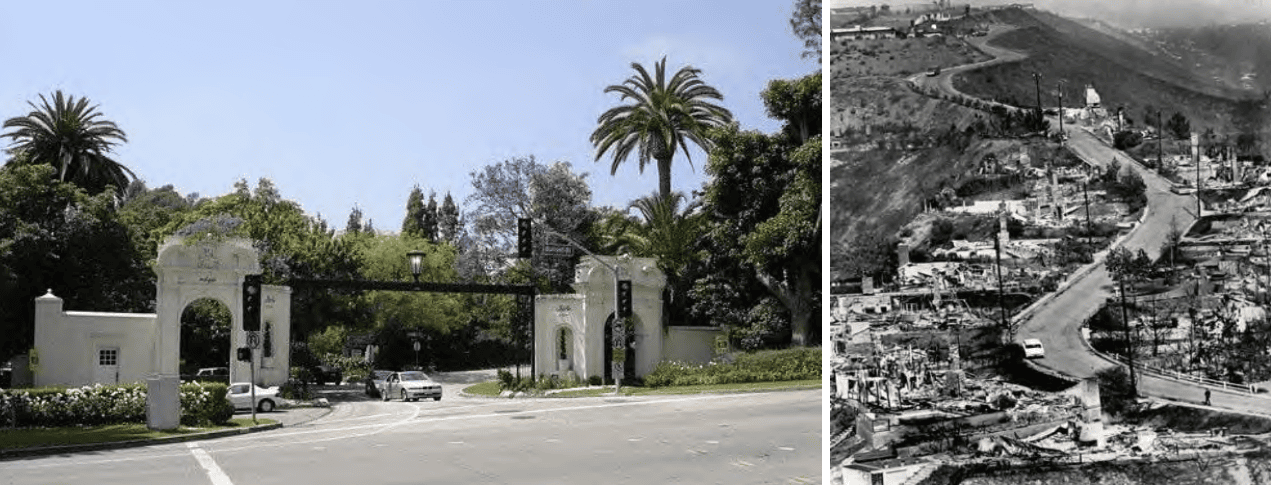
Perhaps, nowhere else was the “Ranch House” expressed more elegantly than in Bel-Air, where many of the wealthy homeowners chose the style to enjoy the outdoor lifestyle of Southern California. Wood shake shingle roofs were an almost-mandatory feature of this rustic style. They were a mark of luxury. They were also raw kindling for the embers and flames that reached the roofs on the warm winds. By 8:30 a.m., fire engines were rolling from stations across the Losngeles (City) Fire Department’s command to what had been declared a “major emergency.”
Many crews fought the blaze with a “hit and run” tactic, going from house to house to extinguish burning roofs before the full structure was involved. In five hours, all the off-duty fire personnel were recalled to contribute to the effort. Riding 100 mph gusts, the fire jumped the Sepulveda Pass and the 405 Freeway to begin feeding on Brentwood and Mandeville Canyon. Converted WWII warplanes were brought in to establish fire breaks with borate mixture drops. A fire chief was provided with a news helicopter from KTLA, a local television station, to get an overview of the fire for better planning of the campaign to get it under control [the first helicopter ordered by LAFD had not yet been delivered]. Coverage from the daring flight above the flames was broadcast to anxious viewers in Southern California.
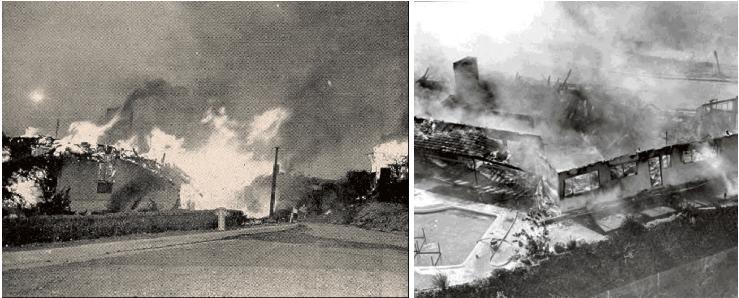
By the next day, Los Angeles County had provided six fire engines and crews to back up City stations emptied out in the fight to control the fire. Ultimately, 400 more County firefighters joined the forces fighting the flames, bringing the total to 2,500. 250 National Guards supported an LAPD force guarding the devastated area against looters. Around 3:00 p.m., the winds began to die down. Journalists and TV reporters, who were prevented from entering the area on the day before to keep the narrow, curving roads open for emergency vehicles and evacuees, were now able to visit the ravaged community. They encountered celebrities viewing the ashes of their homes and lives and listened to retellings of the experiences they had had. Fire does not discriminate – it injures the great and the humble equally.
Zsa Zsa Gabor took an overnight flight from New York to return to LA. She walked between the two fireplaces still standing in the mound of the ashes of her home, telling a reporter of the many mink and sable coats – a personal trademark – that were now dust at her feet. She scraped around in search of her fabulous jewelry – another trademark. Richard Nixon, now an ex-Vice President, an author and a soon-to-be failed candidate for the Governorship of California, posed for some staged photographs, watering down the roof of his rented home with a garden hose and carrying suitcases with his wife Pat, as they re-enacted their evacuation. Kim Novak and Maureen O’Hara had chosen to defend their homes in the same way portrayed by Mr Nixon. Fred MacMurray, Richard Boone and Robert Taylor successfully fought to protect their homes from the fire’s reach. Joe E. Brown, Joan Fontaine, Dennis Hopper and Burt Lancaster suffered the fate of Miss Gabor.
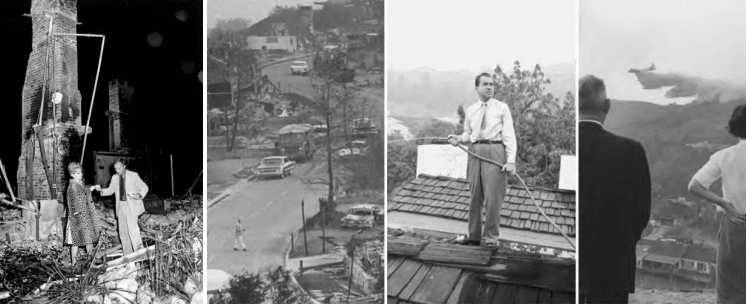
By the morning of the 8th, the fire was fully contained. The aerial tankers were cited for their key role in this achievement. 6,090 acres burned, 484 residences were destroyed, 190 were damaged – small, in comparison to the giant disasters that have devastated the West Coast in more recent years. 78% of the houses in the area were saved and no lives were lost. The loss of real estate is difficult to imagine or calculate in current dollar values.
The patch of burning brush along Mulholland had grown into a nationwide celebrity in its own right. The most popular magazine of the time, Life, covered it with an article titled “The Tragedy Trimmed in Mink.” What was gained from the fire was a heightened public awareness of the importance of preparing for its effects. In Southern California, firefighting procedures were revised, new equipment was created, new regulations were written for protective landscape maintenance and new building codes were issued to better protect structures. Shake shingles roofs were eventually banned, though Southern California’s love affair with the look lingered on like the memory of an old romance.
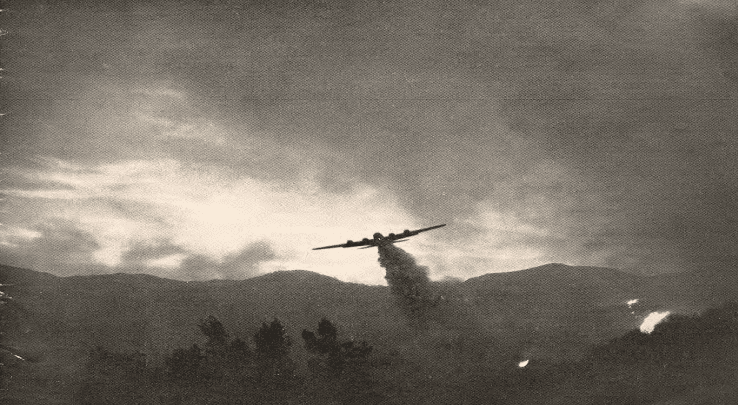
In a sequel that was inevitable for a city that had established itself as the world capital of motion pictures, in 1962, the Los Angeles Fire Department produced and released a 26-minute documentary about the Bel-Air Fire, narrated by William Conrad, titled “Design For Disaster.” https://youtu.be/yj0rfeF5GbA
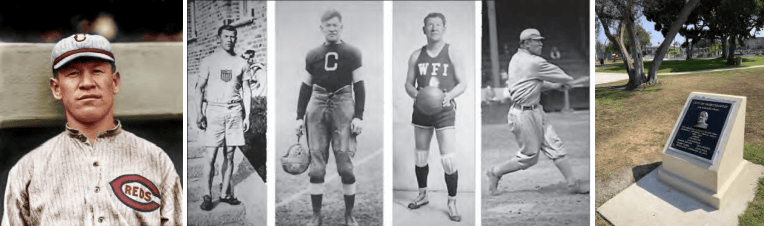
Jim’s back!
After being abducted earlier this year and presumably destroyed by jerks looking for easy money, Jim Thorpe’s image is back to honor the park dedicated to the memory of his life and the part of it he shared with his friends in Hawthorne. The hardships he endured and the spirit he showed in rising above them to be an incredible athlete and a gent are a heavy reproach to the stupid delinquency of those who ruined his monument. They got a few pounds of bronze. He won gold, greatness and ultimately, the true respect of his fellow men who were keen to restore the tribute to him that stands a few steps from our Museum (where you can learn more about the life of our extraordinary fellow citizen).