
HAWTHORNE HISTORICAL SOCIETY
PRESERVATION. COLLECTION. RESEARCH. INTERPRETATION.
October
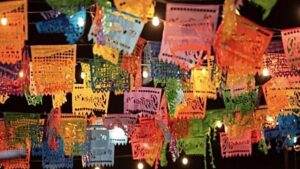
Let’s begin with the end of the month that is now rushing by, trailing behind it the last months of the year and all the important holidays that demand our attention. On the last evening of October, the spirits of the departed will return to commune with us, to smile on the playful revels of our children and to linger for a day or two more, to receive our loving respect on Día de los Muertos, the observance we have learned from our neighbors of Mexican heritage. Remembrance will play a supporting role in the holidays that come later on, while gratitude, reverence, joy and renewal take center stage.

We will have to remember, too, all the things that have to be done to make the holidays right and start the work to accomplish that goal. Your schedule will be growing while your time until the end of the year will be shrinking.

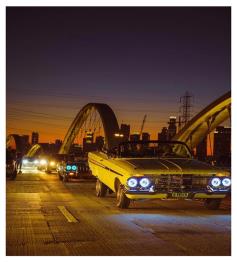
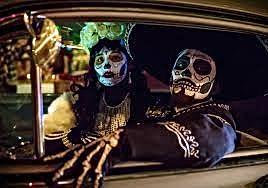
But, don’t let it get you down, man. Slide behind the wheel of your low slung, hydraulically-suspended, elegantly-decorated classic car and ride – low and slow – into the coming season.
“Well I got me a fine wife I got me an ol’ fiddle
When the sun’s comin’ up
I got cakes on the griddle
And life ain’t nothin’ but a funny funny riddle
Thank God I’m a country boy!”
-Sung by John Denver, Written by John Martin Sommers
While you’re parked in bumper-to-bumper traffic on the freeway, or waiting in line at the DMV, or creeping forward in the lineup to drop the kids off at school, you keep telling yourself that as soon as you hit the lottery or make the big breakthrough at work, you’re going to get out of the big city
(Hawthorne) and find that perfect little spot to live in the country. You’ll raise a few potatoes and chickens, sit in the rocker on the front porch and offer apples to the shy little deer. Close your eyes and breathe in that sweet air! Well, don’t look now, but you’re sitting in that country – it’s just
100 years later.
We don’t know what the First Peoples did in Hawthorne, but our “Ramona” hills, the lost Johnson Lake and the “132nd Street” slough must have invited them to spend time in our version of virgin countryside. Antonio Avila, a citizen of newly-almost-independent Mexico, followed the
established Californio agricultural practices for his Rancho Sausal Redondo (of which the future Hawthorne was a small corner) in 1822, running 3,000 head of cattle on the grant. The hides and tallow derived from the herds had been money-making exports since Mission days. By the time a US District Court had the jurisdiction to confirm Avila’s title to the land in 1855, he had added vineyards, cornfields and fruit trees.
In five years, his heirs sold the rancho to wandering Scot, Sir Robert Burnett, who apparently wanted to pause his traveling and try large-scale agriculture. Naturally, Sir Robert added sheep to the livestock, increased the cattle and put in more fruit trees. He also had stands of eucalyptus
and “California” pepper trees planted. The eucalyptus was being promoted at the time as a fastgrowing hardwood tree with a low water requirement that would yield resinous timber useful for exposed construction – railroad ties, bridgework, etc. (it didn’t). The pepper (unrelated to the spice) was a fast-growing, low water tree from South America widely planted at the missions to provide billowy shade. Burnett ended his agricultural interlude in thirteen years, returned to Scotland to head up his clan and leased the property to the Freemans.
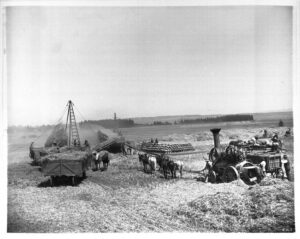
Daniel and Catherine Freeman were Canadians drawn to the touted climate of Southern California. Though Daniel was a lawyer, he was ready to get his hands dirty, figuratively, in agriculture. He increased the sheep flocks, added more eucalyptus and pepper trees and large groves of oranges, lemons, almonds, limes and olives with wells and windmills to water them – inadequately, as it turned out. In a two-year drought, 1875-76, Freeman was said to have lost 22,000 head of cattle. To be taken with an enormous pinch of salt, the thirst-crazed animals were reported to have drowned in the ocean; nearly half drove themselves off the cliffs of Palos Verdes. Any ol’ country boy would be proud to have invented that tall story. Freeman started dryfarming barley and made a fortune selling this essential ingredient for beer-brewing.
He bought the rancho in 1885 and interested himself in the new business that was beginning to bring the country era of the South Bay to an end: real estate. Simultaneously, a route was being surveyed for a railroad line to bring lumber and building materials from the iron pier and landing at Redondo Beach to the construction boom in downtown Los Angeles.
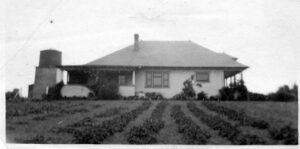
In the 1870s and ‘80s, people from all around the nation were coming to Southern California to stay. They were buying property from the big landowners to start their own farms or ranches, or to hold for further development. The Bennett brothers, Adolph Leuzinger, the Bollinger family, Charles Peck and K. D. Wise were among those who had large holdings to the north and west of the gestating Hawthorne townsite. The long growing season of Southern California allowed the production of succession crops of barley and (dry) beans. The owners of smaller places kept dairy cows, ducks and especially, chickens. Realtors promoting Hawthorne in a 1907 pamphlet (the first lot was sold in 1906) suggested truck gardening, fruit growing and poultry raising to prospective buyers, noting that two of the largest poultry farms were nearby (in Lennox, with processing facilities). Hawthorne residents also kept their own cows and raised cattle and pigs, which they sold at a packing house where the South Bay Galleria now stands.
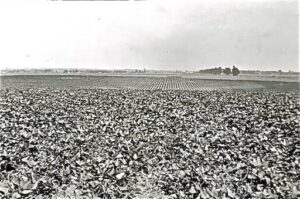
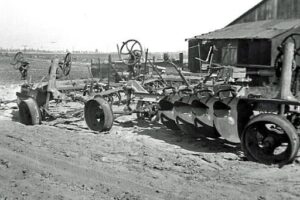
Despite racially-restrictive federal and State laws prohibiting land ownership, several Japanese families managed to produce abundant fresh vegetables for the LA market on small plots of difficult adobe soil they worked at the eastern and western edges of Hawthorne. Nearer to the city’s center, the Satows upped the game by cultivating carnations and other flowers for the floral market. The Nakais established a nursery business that is approaching its centennial. As Hawthorne grew, a network of railroad lines and interurban railway tracks was being built to serve the expanding commerce and to provide transportation for the growing population of Southern California. Open land was being consumed by new towns, houses and businesses; the countryside was slowly beginning to vanish. By the mid-20th century, only vestiges remained (who could forget driving through Dairy Valley – now the City of Cerritos – with the car windows down?), but a faint memory and a simple country spirit survived.
So, you don’t have to pull up stakes and move to some homestead deep in the hills to get in touch with your country roots. Beneath your feet or in your neighborhood, the soil has been tilled, cattle have roamed, fruit has ripened, sheep have grazed, timber has been felled, flowers have blossomed, or crops have been harvested and you have a connection to the land. You can grow a little corn and some potatoes in your back yard. You can sit on your front porch and watch the squirrels, raccoons, possums, skunks and peacocks that roam this wild landscape. This is your country. Ain’t life just a funny funny riddle?
Our Name in Neon
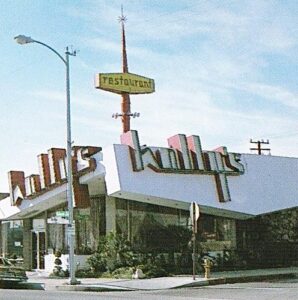
Holly’s, a mourned monument of Mid-Century Modern commercial architecture, was opened by George Polous and Angie Pappas on the southwest corner of Hawthorne Blvd and 137th Place in 1956. It was designed by the now legendary team of Armét and Davis in the style christened “Googie” in 1952 by Douglas Haskell, editor of House and Home magazine, to designate the new style developing in Southern California to shape coffee shops. To attract customers, it showcased convivial diners behind walls of glass and beneath a fascinatingly folded roof, visible at some distance to peckish travelers. The partly embedded letters of the sign stood up beyond the roofline, beckoning. For decades, Holly’s served enthusiastic guests with meals like the memorable Dreemburger De Luxe, but changing times and lifestyles sent it on toward its inevitable conclusion.
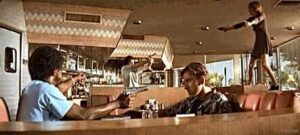
After it closed, it was immortalized by Quentin Tarantino, who had been an appreciative patron of the restaurant before his days as a celebrated filmmaker. He chose it as the location for the opening and final scenes of his 1994 tour-de-force, “Pulp Fiction.” Ensconced in a booth, John Travolta listens to Samuel L. Jackson philosophize about an epiphany he had earlier in the day concerning a hit man’s place in the greater scheme-of-things. When a couple of amateur criminals disrupt his musings, he brings the storyline to its non-lethal end with chilling restraint.
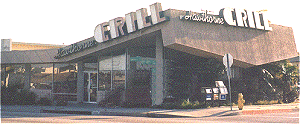
The coffee shop was briefly and bravely rescued by Chris Garnreiter and the wave of nostalgia for “cruisin’” 50s car- and diner culture as The Hawthorne Grill, but the lights went out in 1996. By 1999, the relentless march of time replaced it with a newer building and business serving our community in a different way.
Nevertheless, Hawthornians can take heart in the knowledge that Holly’s sister Googie-style coffee shop [Harry Harrison, 1957], Chips (recognized in 2023 by the Hawthorne Historical Society Hall of Fame for its ongoing contribution to our community) still welcomes patrons at 11908 Hawthorne Blvd.
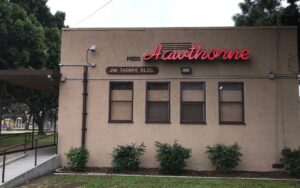
A section of the classic neon sign that adorned Holly’s successor, The Hawthorne Grill, has been preserved and restored to brightly greet all who pass our Museum, from the Jim Thorpe Building (where we are located) at Jim Thorpe Park, 14100 Prairie Ave, Hawthorne.
“What Did You Do in the War, Daddy?”
TV journalist Tom Brokaw promoted the Americans who came to adulthood in the Great Depression and the succeeding Second World War as the “the Greatest Generation.” While most generations have their own daunting challenges to face, “the Greatest” certainly overcame theirs with a courage and tenacity that justifies the title.
As war engulfed nation after nation, young Americans put aside their jobs, their studies and their personal lives to form the military forces required to oppose governments bent on conquest and oppression. Young or old, serving or civilian, everyone’s lives were changing as the war came to America in a lightning stroke, late in 1941. The goal then was to transform our country into a victorious power that could restore peace, order and justice to a shattered world.
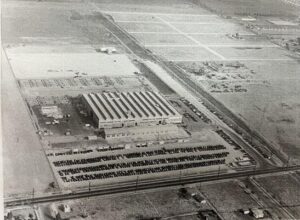
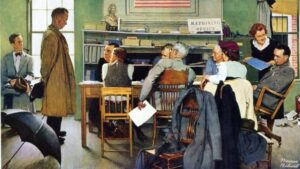
Hawthornians bid farewell to loved ones departing for the hazard of military service. They left leisure behind or changed jobs to swell the workforce of the local aircraft industry – including hometown Northrop Aircraft – and other factories that produced the weaponry for the struggle to come. They altered their working hours and lives to keep the effort going round-the-clock. To assure that those in our military forces had everything they needed to face our enemies, civilians accepted a system of rationing of vital materials, foodstuffs and finished goods. Our people thought of the USA as “the homefront;” they were united with our soldiers, sailors and airmen abroad.
Having witnessed the staggering inflation created by the US entry into World War I, the Roosevelt administration established the agencies that would become the Office of Price Administration (OPA), more than a year before the attack on Pearl Harbor. Their object was to put a ceiling on the prices of goods that would become essential for national defense and to ration the available supplies of automobiles, tires, gasoline, fuel oil, coal, firewood, nylon, silk, shoes, sugar, meats, dairy products: milk and butter, coffee, dried fruits, jams and jellies, lard, shortening, cooking oils, processed- and canned foods, while maintaining a fair distribution of the products.
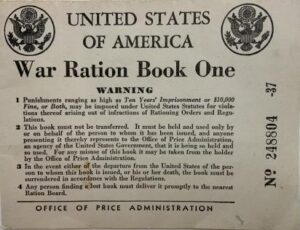
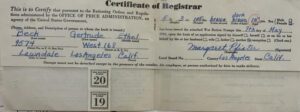
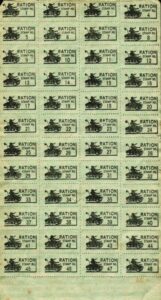
Among the collection of artifacts gathered in a display commemorating the adolescence of Gertrude Beck – a young resident of Lawndale and a 1944 graduate of Leuzinger High School – is the first War Ration Book issued to her (as it was to every American) by the OPA in May, 1942. (The collection is a recent acquisition of the Society, generously donated by her relatives, the Wadman family) A buyer had to present the correct combination of ration stamp denominations, detached from the book, totalling the posted ‘points’ required, along with the cash price, to complete her purchase of an item from a seller. But with rationing, having the necessary stamps and funds didn’t guarantee that the merchandise the buyer wanted would be available.
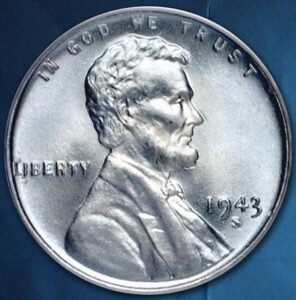
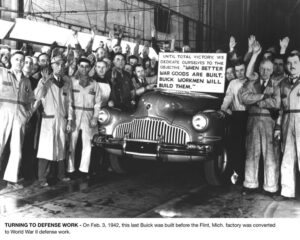
The flow of new cars from the country’s assembly lines slowed to a trickle in early 1942 and then dried up as the automakers retooled to build the vehicles for the conflict: everything from jeeps to tanks to four-engined bombers. The principal suppliers of rubber to the US – Malaya and Indonesia – had fallen under the control of Japan, so Americans were limited to owning five tires, and new tires were unavailable, except to a tiny group of people whose travel was deemed critical. “Owing to a shortage of copper during the critical war year, 1943, the Treasury Department resorted to the use of zinc coated steel for our cents.”* In a period when the average car mileage ranged between 12 and 18 miles per gallon, most car owners were allowed four gallons of gas per week with an ‘A’ sticker displayed on their windshield; a nationwide speed limit of 35 mph was enforced. Original “Red“ was discontinued from the color selections of Homer Laughlin Fiesta tableware as supplies of glaze ingredient, uranium oxide, were confiscated by the government for use in the (Top Secret-) Manhattan Project.
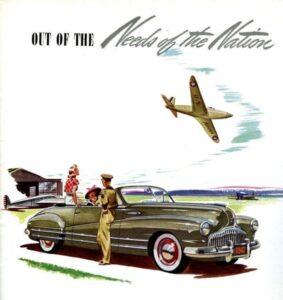
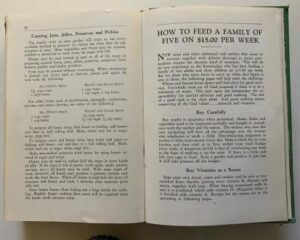
But Americans are nothing, if not clever. They created numerous ways to keep aging cars and bald tires rolling. They introduced trendy fashions that reduced the yardage of fabric necessary to construct the garments. They created a flood of recipes and menus to make appealing and wholesome meals of whatever could be gathered for the larder. Articles in newspapers and magazines, cookbooks and pamphlets advised how to make the skimpy weekly meat allowance stretch through several meals, how to make hardy meat substitutes, how to bake pies, cakes and cookies without sugar, how to make tasty dishes with the overlooked products of butchering. Apart from the other contributions made by women to the war effort, at this time, most women were also home cooks.


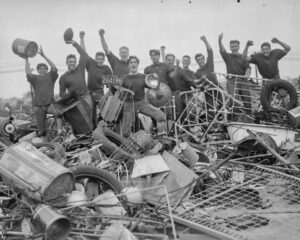
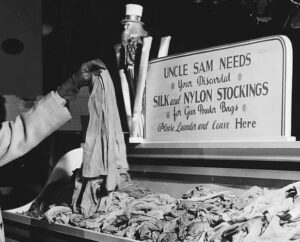
Federal campaigns urged citizens to participate in scrap drives – the Jurassic precursor of modern recycling – to supplement the flow of raw materials used in manufacturing the equipment needed to conduct the war. Eager kids became intrepid hunters of castoffs and disused articles. Many went door-to-door, soliciting contributions of the target material from slightly-ruffled neighbors. Piles of collected items were soon hauled away for processing: aluminum (for airplanes), rubber (for tires and much more), iron and steel, paper, tin, copper (for wire and brass shell casings) household fats (for glycerine and explosives), rags, nylon and silk stockings (for parachutes), 78 rpm records (for shellac for new records). Believe it or not, there was even a program to collect the floss from milkweed seed pods to substitute for the kapok (from sources now under enemy control) used in life preservers.
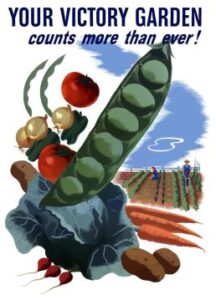
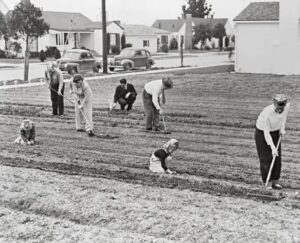
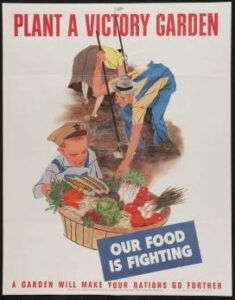
The people revived a tactic from World War I and transformed open spaces in neighborhoods into community gardens, attaching the prefix “Victory” as they had before. These conscientiously tended plots produced an abundance of fresh vegetables and fruit which relieved the stress on the supply chain from farm to table. The neighbors took up the art of canning and preserving to add nutritious food to supplies which dwindled in the winter months.
As adjustments were being made to a way of life, Gertrude Beck and her schoolmates were becoming the young women and men of Lawndale and Hawthorne. They had plenty of changes to deal with during these years of war. In their neighboring communities, everyone shared a feeling that, whatever their differences, they were all in the same boat – all citizens of a country that was not to be trifled with. They focused on positive efforts made together. And they became a memorable generation.
Perhaps, the Covid-19 pandemic is the defining challenge of the present generation. If so, do we measure up – or do we need a little more work?
US population, 1940 census: 132,164,569
US combat deaths in WWII: 291,557
{ 0.22 of a percent of population }
US population, 2020 census: 331,449,520
Current total US Covid-19 deaths: 1,145,958
{ 0.34 of a percent of population }
*Yeoman, R. S., A Guide Book of United States Coins, Whitman Publishing Company, Inc., Racine, WI, 1978
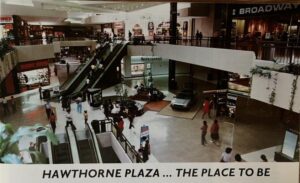
Looking for the opportunity to demonstrate your “genius” on a sequel to the Apprentice? The former Hawthorne Plaza mall is on the market, according to Jack Witthaus’ “Los Angeles County Shopping Center Abandoned for Decades Goes Up for Sale,” Oct. 16, 2023, CoStar.com.
Calendar of Events for 2023
Wednesdays, November 1st and November 15th
6:00 PM to 9:30 PM
At Your House:
Tuesday, October 24th – Halloween Home Decorating Contest
Tuesday, December 12th – Holiday Home Decorating Contest
For information call 310-349-1640;
Enter at parksrec@cityofhawthorne.org
Saturday, October 28th, Halloween Spooktacular Carnival
3:00 PM to 6:00 PM, Memorial Park
Saturday, December 16th
6th Annual Winter Wonderland Spectacular
4:00 PM to 9:00 PM, memorial Park Community Center
