
This month we observed the anniversary of the birth of our nation. The day we have chosen is not the anniversary of the actual establishment of the nation, but the day when the dream of that nation was put to paper. It took our predecessors nearly twelve more years to agree to the final terms – our Constitution – that would bind the people living in the freed British Colonies, and us, in one new kind of society, one people.
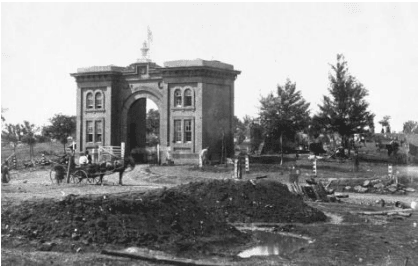
Since then, we have often debated and even fought over the meaning and application of those terms and the subsidiary laws they engendered. There was a terrible time when the United States of America were divided states. In a small country town in Pennsylvania on this anniversary in 1863, over 7,000 young Americans lay dead on a battlefield and 42,000 more were casualties or lost, in a fight over the meaning of those terms. There is no use in turning aside or not speaking of the fact that today we are again divided, though not as severely as in the past. We hold a range of views so different that they support the proposition made by some modern physicists of the existence of alternate universes.
Our members might agree that it is not within the province of the Historical Society to enter into the political discussion, but history is being made today and every day. Commenting on history is part of our work. Let’s remind ourselves that we are – all of us – still one people, no matter how we argue who gets in and who gets left out. Thanks to all those who have brought us here from 1776, we are the most fortunate people, both in wealth and self-governance, on earth. We have work to do to meet our responsibility to the future to make it better. We will have to give up the strongholds of our rigid views and meet somewhere nearer the center to work together. We’ve done it many times before.
Next year in July, we will celebrate our “Bisesquicentennial,” or “Semiquincentennial” or “Sestercentennial,” (we probably won’t agree what to call it) – the 250th anniversary of putting the dream of a nation “of the people, by the people, for the people” to paper. Hopefully, we will put the politics, the jingoism, the anxiety, the distrust, the anger, the intolerance aside and just be grateful — together — one people. E pluribus unum.
Playground
Yeah, even a hundred years ago (or more), it got hot sometimes. What did the people of Hawthorne do in those days to stay comfortable and cool? As little as possible,
probably. Found a big tree or they stayed indoors, shed clothes and drank anything that was colder than room temperature. Well, duh, they had another option: they went to the
beach. Just a few steps away from the center of town at Broadway and Hawthorne Ave (- Blvd), was a place where the Red Cars (the Pacific Electric Railway) stopped. You could get to the beach or almost anywhere in Southern California from there. Hermosa and Redondo Beach, no problem. Santa Monica and Venice, likewise. Messrs Harding and Lombard had created the townsite of Hawthorne in an era of glittering beach resorts that were themselves a progression from waterfront port developments.
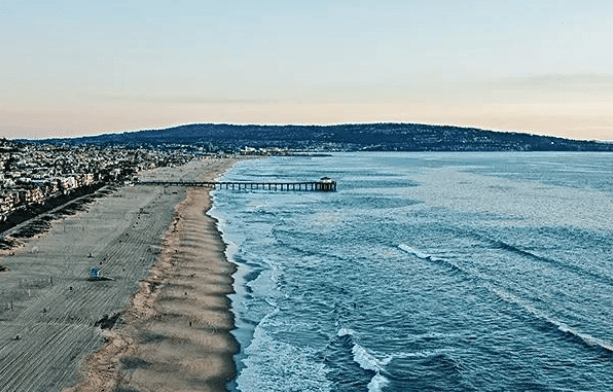
As Los Angeles was growing into a major city in the 1880s, she required more sophisticated infrastructure for handling ocean freight than the mere landing of cargo on beaches from ships anchored offshore. Shipping line owners, land developers, freight carriers and local railroad operators joined forces to create port facilities at several competing locations – among them, Santa Monica, Port Ballona, Redondo and San Pedro. Since you can’t operate a port facility for a major city without up-to-date transportation, railroad executives toiled to lay track connecting the docks, piers, berths and wharves with the main railroad terminals and yards in downtown Los Angeles.
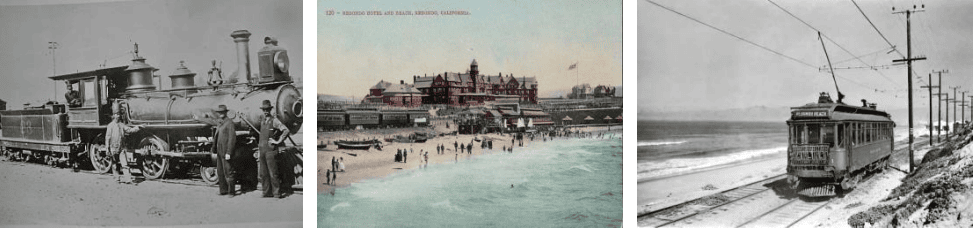
Capt. J. C. Ainsworth and Capt. R. R. Thompson, a pair of lumber barons and shipping magnates from the Pacific Northwest, came to town in 1888 looking for land and
transportation to get their product from the coast to the lumber-hungry center of LA. They bought land to build docks and wharves at the south of the little beach town of Redondo and gobbled up a short (steam) streetcar line that was intended to serve a residential development along Vermont Ave, called “Rosecrans,” that had failed to materialize. They built lines northward from Agricultural (later, Exposition-) Park to Los Angeles and southward to Gardena, swinging southwest to Redondo, calling it the “Los Angeles & Redondo Railway.” Santa Fe was laying track from LA through Inglewood to Port Ballona, a project to create a harbor from a shallow lagoon at the mouth of Ballona Creek. When building conditions proved the plan to be unworkable, they rerouted track to Santa Monica and also south along the South Bay beaches. Redondo became a working port with infrastructure to get freight and passengers to and from the principal city of Southern California. [Perhaps unfortunately, Phineas Banning and Senator Stephen M. White used their influence to get Congress, in 1897, to designate the dredged mudflats at San Pedro the official Port of Los Angeles]
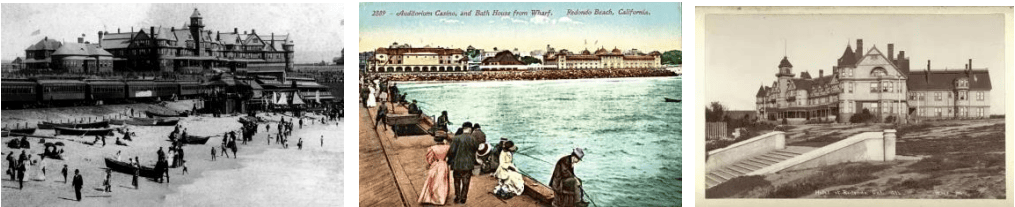
In the realm of “if you build it, they will come,” travelers arrived in Los Angeles by rail and by ship, many looking for the advertised wonders of this new Eden on the Pacific. Hoteliers and entrepreneurs anticipated their needs by creating resorts on the shores of the Santa Monica Bay (at least the southern half of which was identified on old maps as “Shoalwater Bay”). While the international café society could cross an ocean to gather at the de luxe watering holes of the Riviera, others could ride across a continent to play on the sands of Southern California beaches. The two captains of the shipping and lumber industries saw Redondo as an ideal site for a world-class vacation destination, resort and playground. They got busy erecting a vast, 225-room hotel spreading across a knoll* above the wharves and docks in fashionable Victorian turreted style with a unique streetcar terminal at its feet. The Hotel Redondo opened in 1890. Every room was
furnished with modern conveniences and public spaces included an impressive Banquet Hall, two bowling alleys, a billiards room and a spacious Veranda, where guests were regularly entertained by bands or musicians before a panoramic view of the Bay. The hotel was surrounded by large, landscaped gardens that invited strolling and sitting. Tennis courts and a golf course adjoined the grounds and to the east, guests could enter a 12-acre carnation garden where the flowers were grown for the commercial market of Los Angeles. There were cottages to rent for a more exclusive stay and even a Tent City – permanently fixed accommodations with wood floors and electricity – for visitors on a budget. An impressive staircase drew guests down to the features developed along the shoreline as Henry Huntington and Pacific Electric took over the now-electrified railway, the hotel and most of the real estate in 1905. Here, even the working class of Hawthorne could enjoy the attractions.
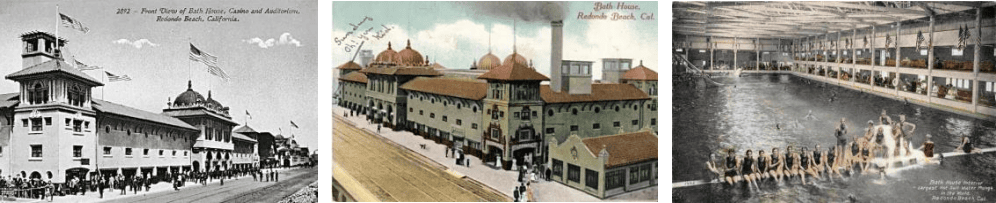
Along “El Paseo,” the Casino, which was originally opened in 1892, rose again, phoenixlike, in 1907 after being destroyed by fire during remodeling. It contained a popular café and a line of newly-developed slot machines. Next door, the large Pavilion featured the Mandarin Ballroom on its upper floor. On the north side, the Plunge or bath house contained both salt water and freshwater pools. The water in each was heated and the huge salt water pool was advertised as the world’s largest. A pioneering roller coaster, the Lightning Racer, was raised on one of the piers in 1913. The simpler pleasures of angling from a wharf, walking along the shoreline and searching for moonstones were available to all who came.
Long before they had a car in every garage (ha-ha!), early Hawthornians were spoiled with options for a visit to the beach. The streetcar and interurban services that met in the center of their newly-established town could take them to a selection of beach towns that offered a full menu of seaside entertainments. Abbot Kinney was once an Indian Agent who had hosted Helen Hunt Jackson, a writer and activist for restoration of Indian rights who made her argument in her popular novel, Ramona. He had since moved on to real estate development, and with a partner, had acquired a stretch of coastline south of the sleepy village of Santa Monica to the marshes near Ballona Creek. In 1895, they opened Ocean Park, a residential community with a golf course and a horse-racing track at the “Ocean Park Casino.” When his partner died three years later, a coin toss with the heirs made Kinney owner of the southern half of the property.

In 1905, fifty years before Walt Disney opened the definitive model for all the theme parks of the modern world, Kinney introduced Venice of America, now Venice, CA. In addition to a 1,200 ft long pier, Kinney had created an Venetian-themed “amusement town,” including an arcaded façade ornamented by brilliant/eccentric sculptor, Felix Peano, who would later live in Hawthorne. A ship restaurant was “tied up” to the pier and within a few years was joined by the rides and features that were beginning to define this kind of business: a “Whip,” a “Racing Derby,” a “Virginia Reel,” game booths, an Aquarium and others. At the shoreline, there was a dance hall, an auditorium and a heated salt water plunge. Visitors could ride through this collection of entertainments on the steam powered Venice Miniature Railway. Most notably, Kinney had used the remnants of the failed Port Ballona to create a network of canals on which visitors could be transported in authentic gondolas.
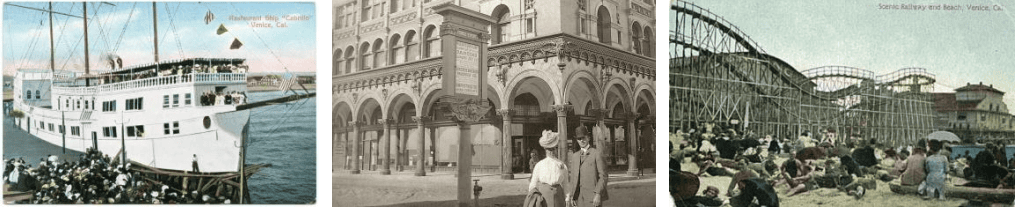
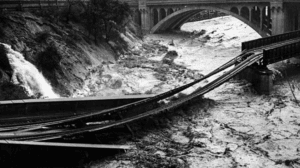
To the north, Santa Monica annexed Ocean Park and continued its effort to attract visitors. A large beachside hotel, the Arcadia, welcomed guests in 1887. The Long Wharf, a mile-long combination wharf and pier had been built by a predecessor and then Santa Fe Rwy in 1892, exclusively for freight, in an attempt to establish Santa Monica as the port of Los Angeles. A strictly-for-amusement pier was built at Santa Monica (1909), then another, Fraser’s Million Dollar Pier, at Ocean Park (1913), another, Lick Pier (1922), yet another at Ocean Park (1926). The great ocean, resentful of being called “Pacific,” frequently destroyed the pitiful efforts of man to surmount it with powerful winter storms. Man’s own servant, fire, did the rest. Oblivious, we build again.
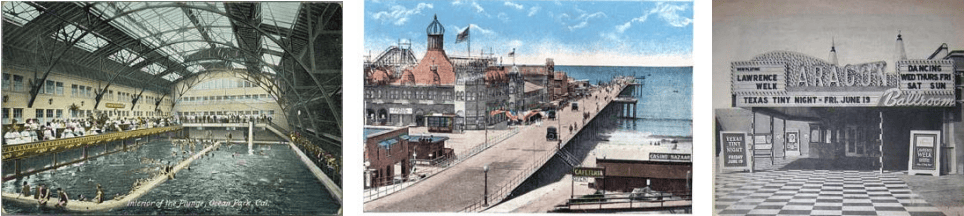
In a less-populous time before freeway traffic jams, smog, parking nightmares, even before beach swimming, surfing** and sunbathing were activities, Southern Californians could escape the heat and find a day of fun where the waters that encircle the globe caress our shores. Hawthorne was created on a line of connection between the great city and the coast and even now, the beach is waiting for us.
*- today, Veteran’s Park
** – Hawaiian George Freeth gave surfing exhibitions at Redondo in 1907 and founded the first surf club there in 1912

Look for the Calendar of Coming Events on the Events feature on our Website
https://hawthornehistoricalsociety.org/events