
December 25, 2025
The Nightmare After Christmas
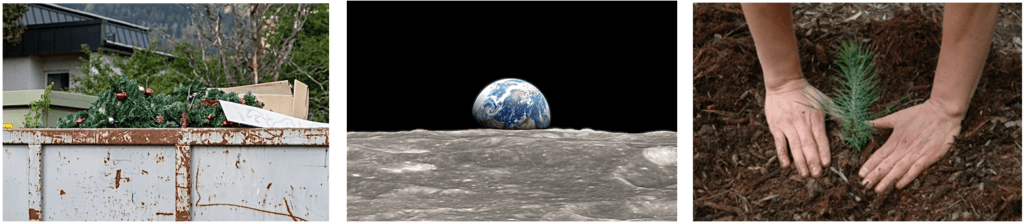
Lately, I’ve been having this recurring bad dream: after Christmas, everyone starts putting their old plastic trees out at the curb for the trashmen to pick up. Bent, sunbleached, branch-missing, short-circuited “trees” that they don’t want anymore, piled by the sidewalk, up and down the street.
 What’s going to happen to them? As an environmentally-responsible society, what can we do to somehow recycle them and protect the fragile remnant of our once-beautiful planet?
 Could we throw them into the ocean to create artificial groves that would serve as nurseries for baby marine creatures?
Could we grind them into an inexpensive mulch that people could spread on their yards instead of installing artificial turf or cultivating a water-guzzling lawn?
Could they be stuck into fire-ravaged hillsides and flats across our state to give the appearance of vegetation, to deter mudslides when winter storms rake the region and to shade emergent natural growth, when or if it ever returns?
Could they be melted into a giant sphere that would be launched into space, providing an alternate home for a seed-population of humans when our Earth is reduced to a smoldering cinder?
Thoughts like these keep me awake at night!
Could we throw them into the ocean to create artificial groves that would serve as nurseries for baby marine creatures?
Could we grind them into an inexpensive mulch that people could spread on their yards instead of installing artificial turf or cultivating a water-guzzling lawn?
Could they be stuck into fire-ravaged hillsides and flats across our state to give the appearance of vegetation, to deter mudslides when winter storms rake the region and to shade emergent natural growth, when or if it ever returns?
Could they be melted into a giant sphere that would be launched into space, providing an alternate home for a seed-population of humans when our Earth is reduced to a smoldering cinder?
Thoughts like these keep me awake at night!
In Our Little Corner Of The World
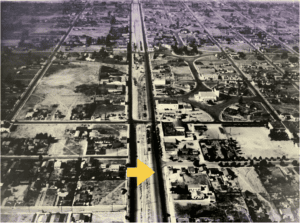 By the 1930s, Hawthorne Blvd was the business and civic thoroughfare of Lennox, Hawthorne and Lawndale and a main route to other South Bay towns and cities from the great metropolitan area to the north and east. In 1930, Los Angeles was the fifth largest city in the US with 1.2 million inhabitants, while an additional million lived within County boundaries. Hawthorne boasted a respectable 6,596 citizens.
Over 800,000 automobiles were registered in Los Angeles County that year as Southern Californians enthusiastically turned to cars for their transportation needs. The needs of the automobiles were supplied by a population of service stations spread across the region, often in downtown locations, where they were accepted as a modern convenience. Streetcars still rattled down the middle of Hawthorne Blvd to Broadway, the entrance to the original center of town, but there were three gas stations within a block of Hawthorne and El Segundo Blvds, the now-central intersection of the City. One station was established at the southeast corner of Hawthorne and Maine Ave – which would become 129th St before the decade ended.
By the 1930s, Hawthorne Blvd was the business and civic thoroughfare of Lennox, Hawthorne and Lawndale and a main route to other South Bay towns and cities from the great metropolitan area to the north and east. In 1930, Los Angeles was the fifth largest city in the US with 1.2 million inhabitants, while an additional million lived within County boundaries. Hawthorne boasted a respectable 6,596 citizens.
Over 800,000 automobiles were registered in Los Angeles County that year as Southern Californians enthusiastically turned to cars for their transportation needs. The needs of the automobiles were supplied by a population of service stations spread across the region, often in downtown locations, where they were accepted as a modern convenience. Streetcars still rattled down the middle of Hawthorne Blvd to Broadway, the entrance to the original center of town, but there were three gas stations within a block of Hawthorne and El Segundo Blvds, the now-central intersection of the City. One station was established at the southeast corner of Hawthorne and Maine Ave – which would become 129th St before the decade ended.
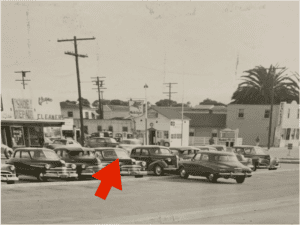 C. R. Godd’s station sold gasoline branded “Mobil” or “Mobilgas” through a complicated corporate web that connected the franchise to General Petroleum products and ultimately to Standard Oil Company of New York, “SoCoNy” – Vacuum Oil Company, a major competitor of Standard Oil of California, “Chevron,” whose refinery was three miles west. At this station, the fuel was pumped beneath a sign bearing the insignia of a red Pegasus on a white shield, now regarded as an iconic, collectible American product symbol. In the coming years, service stations often migrated from confined downtown sites to more spacious locations at heavily-travelled intersections nearer the edge of communities.
Our corner location watched the campus of Washington School reach down 129th toward its perimeter in the ‘40s and the grounds of newly-built Hawthorne Intermediate School abut its property line in 1950. At about this time, smart businessmen replaced the little fuel stop with one of Southern California’s fastest growing enterprises, a drive-in hamburger stand – this one called “Skippy’s.” Reminiscent of the architecture McDonald’s employed to identify their outlets at the same time, Skippy’s featured a rainbow arch across the face of the stand. Though Intermediate students may have needed a parent-approved lunch pass to leave the campus for a midday meal (school grounds had not yet been enclosed in penitentiary-like security fencing), many made a beeline to Skippy’s for a reviving bag of fries or a malt when the bell rang out the schoolday around 3:00 p.m.
C. R. Godd’s station sold gasoline branded “Mobil” or “Mobilgas” through a complicated corporate web that connected the franchise to General Petroleum products and ultimately to Standard Oil Company of New York, “SoCoNy” – Vacuum Oil Company, a major competitor of Standard Oil of California, “Chevron,” whose refinery was three miles west. At this station, the fuel was pumped beneath a sign bearing the insignia of a red Pegasus on a white shield, now regarded as an iconic, collectible American product symbol. In the coming years, service stations often migrated from confined downtown sites to more spacious locations at heavily-travelled intersections nearer the edge of communities.
Our corner location watched the campus of Washington School reach down 129th toward its perimeter in the ‘40s and the grounds of newly-built Hawthorne Intermediate School abut its property line in 1950. At about this time, smart businessmen replaced the little fuel stop with one of Southern California’s fastest growing enterprises, a drive-in hamburger stand – this one called “Skippy’s.” Reminiscent of the architecture McDonald’s employed to identify their outlets at the same time, Skippy’s featured a rainbow arch across the face of the stand. Though Intermediate students may have needed a parent-approved lunch pass to leave the campus for a midday meal (school grounds had not yet been enclosed in penitentiary-like security fencing), many made a beeline to Skippy’s for a reviving bag of fries or a malt when the bell rang out the schoolday around 3:00 p.m.
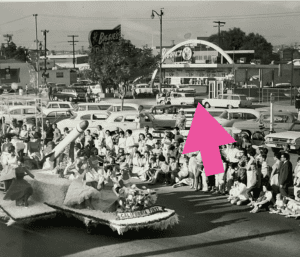 While the burger wars began to heat up with the emergence of competing mammoth fast-food chains in the 1960s, the drive-in business was converted to Biggie’s, though the menu remained pretty much the same.
Del and Helen Johnson started the Sizzler restaurant chain in Culver City in 1958, looking to fill the market gap between fast-food and full-price restaurant service. They offered affordable steak with other attractive features: place your order at the counter but be served at your table; create your own salad at an elaborate salad bar; enticing garlic/cheese toast, affordable lobster, etc. During the 1970s, the popular casual dining chain grew to 270 steakhouses with a Sizzler in Hawthorne where Biggie’s used to be. But (with rare exceptions) nothing in the restaurant business is forever. By the 1990s, Sizzler converted to buffet-style eating, hoping to recapture the interest of younger customers. It didn’t work — and about 70% of the restaurants gradually faltered and disappeared. Since 2023, Sizzler company managers have been working to revive the surviving outlets, relying on the most popular traditional features while upgrading premises and offering new fare. They face a tough challenge in today’s market.
While the burger wars began to heat up with the emergence of competing mammoth fast-food chains in the 1960s, the drive-in business was converted to Biggie’s, though the menu remained pretty much the same.
Del and Helen Johnson started the Sizzler restaurant chain in Culver City in 1958, looking to fill the market gap between fast-food and full-price restaurant service. They offered affordable steak with other attractive features: place your order at the counter but be served at your table; create your own salad at an elaborate salad bar; enticing garlic/cheese toast, affordable lobster, etc. During the 1970s, the popular casual dining chain grew to 270 steakhouses with a Sizzler in Hawthorne where Biggie’s used to be. But (with rare exceptions) nothing in the restaurant business is forever. By the 1990s, Sizzler converted to buffet-style eating, hoping to recapture the interest of younger customers. It didn’t work — and about 70% of the restaurants gradually faltered and disappeared. Since 2023, Sizzler company managers have been working to revive the surviving outlets, relying on the most popular traditional features while upgrading premises and offering new fare. They face a tough challenge in today’s market.
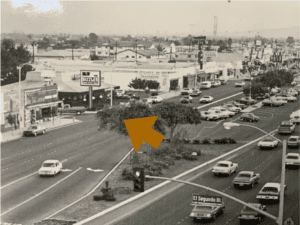 The Sizzler in Hawthorne disappeared in the downtown redevelopment effort of the ‘90s. It was replaced by a mini-strip mall that included (when last recorded by Google Maps) a donut shop, an auto insurance office, a Mongolian barbecue, a dry cleaners, a barbershop and a Thai grill. A trip down Hawthorne Blvd today will not conceal that many downtown businesses struggle in these locations, in these economic conditions, in these times, but Hawthorne has endured difficult times before. We will come up with new ideas, try new concepts, embrace new things, buy new products and services, succeed with new efforts and remain a vital, thriving community in the years to come.