
November 11, 2025
The Twilight Zone
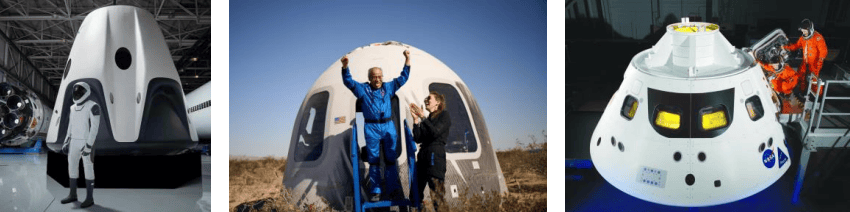
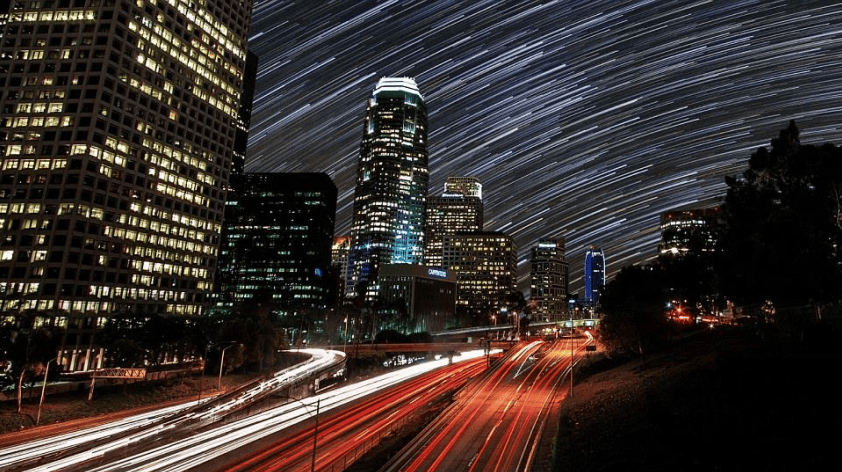
Who needs a billionaire’s ride in a dinky little space capsule? We’re on a much larger spacecraft (2.5 million times larger), furnished with every comfort on Earth, a perfectly pressurized atmosphere, its own moon to light the dark phases of the circuit — hurtling away from the Sun at the incredible rate of 66,000 mph. Holding the best safety record in the industry, this ride lasts one entire year, then begins again. With just a few limitations, you can ride as often as you like. No lines to wait in. No Lightning Lane passes necessary. Room for everyone. And, it’s absolutely free!
Go outdoors tonight. Look up. Watch the Universe passing by.
[Eat your heart out, Jeff Bezos, Bob Iger, Elon Musk!]
Vehicles
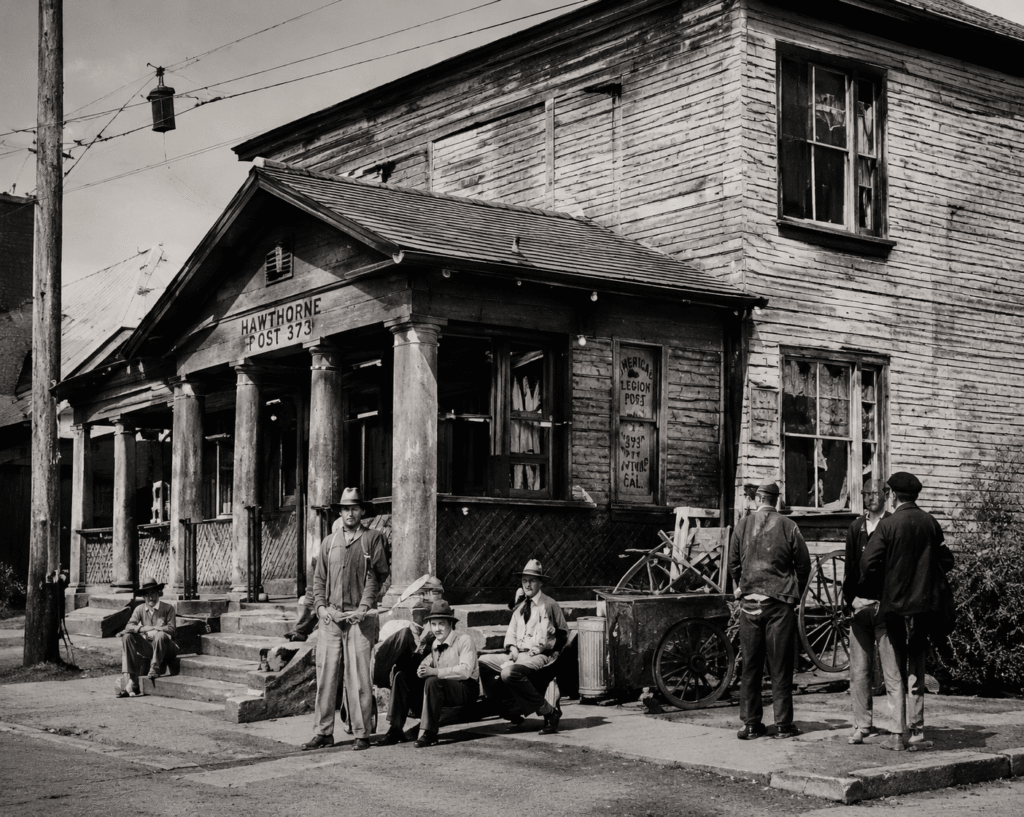
When residents and stakeholders made seventeen-year-old Hawthorne a city, in 1922, she was just another rural population point on the rolling plains of Southern California. Seen from a biplane overhead, Hawthorne was an intermittent row of business and retail buildings along both sides of Hawthorne Avenue (now Boulevard) stretching a few doors east or west at Raymond Avenue (now 120th Street), Ballona Street (now El Segundo Boulevard) and Broadway, including the Broadway Circle (now stratified under the Hawthorne Plaza ruins). The rest was small plots and tracts of vacant land, with far fewer streets than now, dotted here and there with solitary and small clusters of houses, often situated near stands of trees that were remnants of windbreaks or woodlots from agricultural and lumbering days. Paving covered only a few blocks at the center of the city, sidewalks were rare and the land was crisscrossed with paths and roads — dirt, like the streets — that defied the grid plan and offered the shortest route between the places people wanted to be.
The year before incorporation, twelve automobiles were registered at addresses in Hawthorne, though the population had grown to about 2,000. World War I was over, the new decade was going to be known as “the Roaring Twenties,” and cars were evolving from mostly open touring cars and roadsters with canvas roofs that could be raised on jointed frames to more comfortable sedans and coupés that were enclosed in wood-framed sheet metal-and-glass cabins. The lure of the automobile was beginning to entice the people of Southern California, where crossing the vast region quickly from one particular point to another was both an advantage and a hint of the future.
When Hawthornians were ready and able to possess a new car of their own, they first had to travel to dealerships in nearby communities. There were several in Inglewood, our elder sister city to the north. From listings and advertisements that have survived since 1929 to become part of our Society’s collection, we discovered you could have purchased a new Nash from Honaker Nash Motor Co., 223 Market St, Phone 339. New models of the Dodge Four & Six (-cylinder lines), the Chandler Six & Eight and the Gardner Eight-in-Line could be purchased at Quick Service Garage, 206 S. Locust St. The latest Buick was offered at Howard Automobile Co. — Inglewood branch, 636 S. Market St. Both Willys-Knight and Whippet were sold by Whippet-Knight Sales Co., 214 N. Commercial St (now La Brea Ave), Phone 281.
Buying a Ford — probably the car most registered in Hawthorne and certainly the most popular in America — meant a trip to El Segundo, to Ira E. Escobar Ford Products, 304 Main St, Phone 18. Ford Motor Co. had ended the twenty year run of the Model T, the world’s most numerous car, in 1927 and was now offering the updated and stylish Model A. Ford had become the first giant of auto manufacturing in America. Henry Ford bought and added Lincoln in 1922; son, Edsel introduced Mercury in 1939 and Ford Motor Corporation honored him with introduction of the Edsel in 1957.
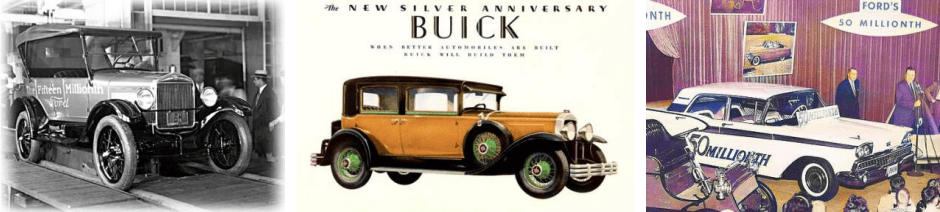
Buick was the founding marque (make) of General Motors, acquired by William C. Durant, owner of the world’s largest horse-drawn vehicle manufacturing business, in 1904. Durant and his associates went on to add several other car manufacturers to their holdings until 1911, when they established the car lines that would carry the future giant corporation into the 21st century: Buick, Oldsmobile, Cadillac, Pontiac and Chevrolet. The Howard Automobile Co. was succeeded in Inglewood by Sparling Buick, whose curved Moderne showroom windows looked out from the wedge-shaped southwest corner of La Brea and Florence Aves on motorists entering downtown Inglewood from the north.
The dream of owning a new car faded for many as the decade of the 1930s brought the economic decline of the Depression to Southern California and the world. The downtrodden people of Hawthorne, like their fellow citizens across the country, could look to the movies and their stars to see the stylish and luxurious evolution American cars were passing through, and could aspire to owning one when better times arrived. As hard times slowly began to ease in 1938, our listings show that Hawthornians could admire new De Sotos and Plymouths at the F. R. Adler Co., 204 N. Market St, Inglewood, Tel. 1115, or Studebakers at Frank H. Afton Co., 240 N. Market St, Tel. 455.
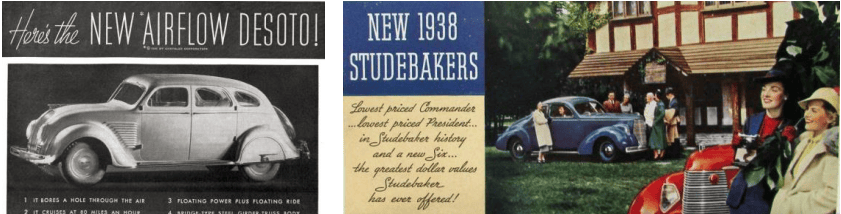
De Soto and Plymouth were makes that Walter C. Chrysler added to Dodge and Chrysler to form the Chrysler Corporation in 1928, the third giant of vehicle manufacturing in the United States. De Soto had been chosen as the marque to share the revolutionary “Airflow” styling with premium-priced Chrysler in 1934, the first American cars to use aerodynamic principles to reduce wind resistance by enveloping protruding features in a smooth body envelope. Conservative car buyers of the time did not embrace this degree of change in design. De Soto reverted to more conventional styling in 1937, Chrysler in 1938.
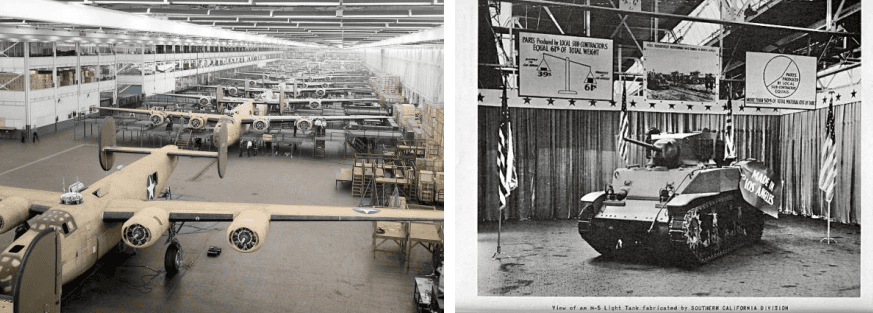
New car buyers had no choices to make from the spring of 1942 until the summer of 1946, after the US entered World War II and the government converted auto manufacturing facilities to the production of war materiel. Full employment at substantial wages with spending options restricted by rationing made Americans better off and ready for better times. The population had kept worn-out cars running through the years of the conflict and were now eager to replace them. The Postwar era saw years of auto sales like never before.
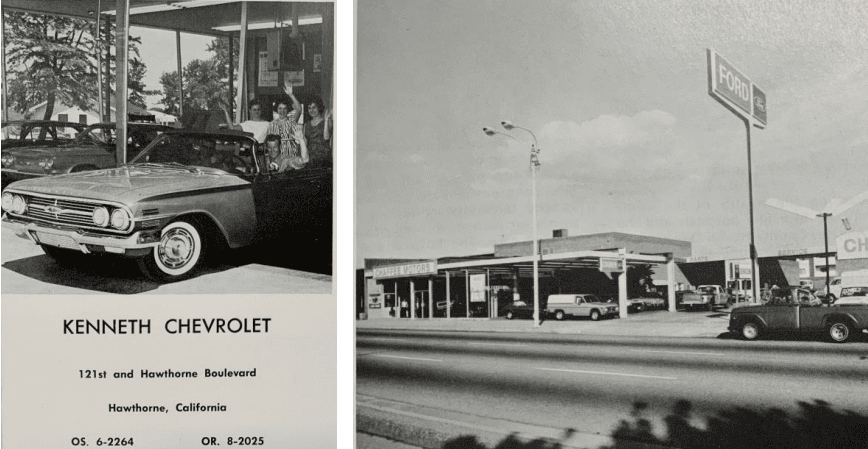
Auto dealers now recognized Hawthorne as a prime location for sales. They opened showrooms and dealership facilities in our city and prospered. The hunger for cars in the American public was whetted in the 1950s, not only by world-class advertising, but by the National Interstate and Defense Highways Act of 1956. Promoted by the Eisenhower administration, the program aimed to create a nationwide network of “superhighways” to promote commerce and aid defense if conflict ever again required a robust transportation system. It also offered citizens a system of spacious, high-speed open roads to travel throughout the continental US without restraint. All we needed were powerful, comfortable, stylish new cars from local dealers to accept the invitation. [Always at the forefront, Southern Californians called the highways “freeways” before the rest of the country got their “Interstates.”] Our listings from 1959/60 include the city dealers ready to supply the dream cars to satisfy our wanderlust. We could “See the USA in a Chevrolet” from Kenneth Chevrolet, 422 N. Hawthorne Blvd, OS 9-3311, or a Ford from Chaffee Motors, 1212 S. Hawthorne Blvd, OS 5-7171, if we were a loyal buyer of that marque. Bob Keefer, 500 N. Hawthorne Blvd, OS 9-2521, provided the latest Plymouth models to round out offerings from the three great car manufacturers.
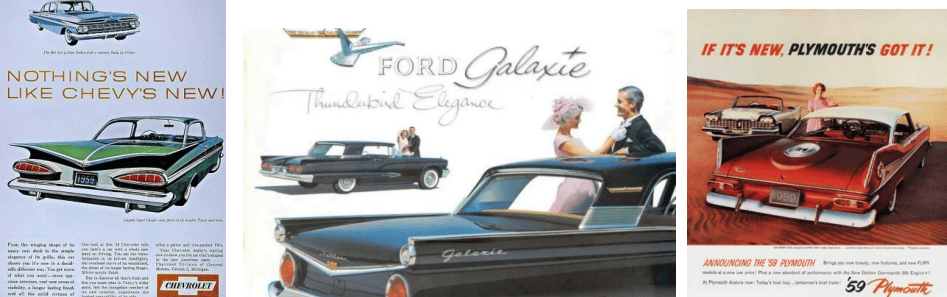
By the 1960s, automobiles had become a way of life in our nation: most family members dutifully learned to drive when they reached sixteen and multiple-car families were common. The range of daily life for the average person widened geographically. Streetcars and interurban railways were driven to near extinction. The ability of children to walk to school atrophied.
The economies of many countries devastated by WWII, in Europe and in Japan, slowly recovered and they were able to produce clever, smaller cars to follow the example of mobilization created by Americans. They were allowed to export conforming models to our country where they provided cute, inexpensive alternatives to the “longer, lower, wider” vehicles American manufacturers coddled the public with. American manufacturers welcomed the competition with their own versions of “compact-“ and “sports” cars.
The listings we found from 1976 reflect the rather incredible range of automobiles that were on offer to residents of the South Bay. The freeways of the time became a catalog of cars from America and the rest of the world, passing (ever more slowly) in review. The major thoroughfares of the South Bay became an international marketplace for autos that would suit almost any taste, any need and any budget: Webber American Inc., 15211 S. Hawthorne Bl, Lawndale, 679-3361, sold American Motors products — Ambassador, Matador, Gremlin, Javelin, Hornet — nearing the end of a long evolution from the Nash and Hudson makes. Lyons’s Giant Buick Center, 18800 Hawthorne Bl, Torrance, 370-6383, was an early example of an autocenter, where all services and functions were combined at one site. They also sold Opel, an import from West Germany. Hessell Chevrolet, 1875 E. El Segundo Bl, El Segundo, 322-0280, became a local source for the venerable marque after the Hawthorne Plaza mall buried Kenneth Chevrolet. Datsun, the popular Japanese rival of Toyota, was sold by Gillilan Datsun, 1210 S. La Brea Ave, Inglewood, 674-2212. The make was re-branded to Nissan, circa 1986. Bob Hansen Motors Inc., 4549 Rosecrans Ave, Hawthorne, 675-1158, offered two makes: International Recreation Vehicles and Jeep models CJ-5, Cherokee, Wagoneer and Truck, for the recreationally inclined, long before the Sport Utility Vehicle bubbled up in auto manufacturer’s minds. Luxury Lincoln models and their plush Mercury juniors were on view at Bob Estes Lincoln Mercury, 964 S. La Brea Ave, Inglewood, 671-7676. They also offered Capri, a Ford-owned, German-built sports coupe that was marketed as “the European Mustang” and was very popular with style-conscious young Americans for a time. In two years (1978), Torrance Mazda, 4343 W. 190th St, Torrance, 542-8511, would be introducing the stylish RX-7 sports coupe with the revolutionary (pistonless) Wankel rotary engine. Bob Curtis Oldsmobile, 3111 Pacific Coast Hwy, Torrance, 325-4321, sold the middle line of General Motors’ products — spacious, stylish, swift rides for those who chose to step up from the economy brands. Speaking of stylish, they offered the French Peugeot as well, fashionable as a Chanel suit. Scott Robinson Pontiac-Honda, 20340 Hawthorne Blvd, Torrance, 371-3521, had a strong combination of a popular American standard and a leading Japanese import. Who would have imagined that the car division that developed the GTO, the Grand Prix and the Firebird would one day be one of GM’s retired marques? Today’s mega-brand Toyota would grow from ubiquitous dealerships like Webber Toyota, 4419 Redondo Beach Blvd, Lawndale, 370-6286. Beginning as a “people’s car” in the troubled Germany of the 1930s, Volkswagen would have its era as the most numerous car in the world and would come to Hawthorne at Mirkin Motors Inc., 12139 Hawthorne Blvd, 679-0201. Reflecting the Scandinavian character, sturdy Volvo would become popular in the US and available at South Bay Volvo, 234 S. Pacific Coast Hwy, Redondo Beach, 372-8467.
These automobile brands and their dealers are only a representative selection of the multitude of companies that presented their cars to South Bay buyers in hope of being selected for their personal transportation. These are the dealers who sought listings and created advertisements for inclusion in the ephemera that has survived to become part of our collection. There were many more.
The people of Southern California incorporated the car into their lives and culture like no one else on earth — a truly symbiotic relationship. They were among the first to invent and embrace freeways, drive-in cafés, -theaters, -churches, drive-thru fast food outlets, -banks/tellers, etc. Car manufacturers came to Southern California to establish large assembly plants to feed the region’s market, to develop new engineering, new styling and to study customer preferences. It is reflected in the names they used to lend appeal to their models: Bel Air, Hollywood, Malibu, Ventura, El Camino, Silverado, Catalina. Southern Californians were derided by their fellow Americans for traffic jams and smog and were the first and foremost to control air pollution and to improve the efficiency of the infrastructure while building a network of superhighways that truly served the population. Southern California was a center for the development of driver-assisting electronics, hybrid-, alternate fuel- and electric powered vehicles. Hawthorne played an important role in that advancement.
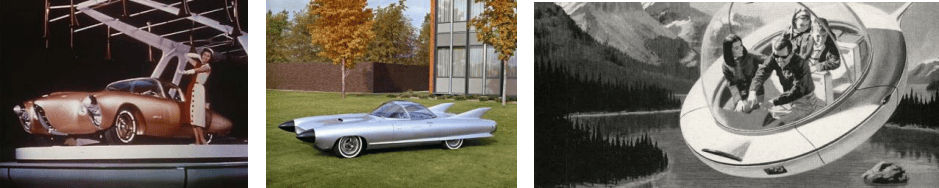
The future forms of personal transportation are as hard to imagine as any aspect of the future in the face of the blinding speed with which our technology now creates new systems to support our needs. Nevertheless, we will doubtlessly embrace them, become accustomed to them and look to outlets in Hawthorne and our neighboring communities to provide them for our selection.