
Mid- . . . . Year
Summer arrives with the fourth week of June and the longest time between sunrise and sunset in the Northern Hemisphere. It was cause for celebration for our ancestors everywhere, particularly for those in daylight-starved northerly European latitudes. To deceive and cheer themselves, they called it “mid-“ summer. They feasted, danced, imbibed, partied, pulled practical jokes and almost universally, made a big bonfire. (Sounds familiar, right?)
Early fathers of the Christian church co-opted the celebration to honor the birth of John the Baptist, determined by means of Julius Caesar’s calendar and a biblical reference to have occurred on June 24th. A days-long period of celebration resulted.
We have work to do if we’re going to honor the traditions we have inherited from our forefathers – and we have all summer!
Watching Summer
School’s out. The sun is coming up in clear skies. The garden’s growing. The birds are singing. The trees are filling the air with oxygen. The day is going to be balmy with the slightest tang of salt in the afternoon breeze. The dogs are frisky, looking for the kids. Where are they?
Obviously, they’re in some dim corner of a room, staring at a tablet- or notebook screen, watching minutes-long episodes of addicting nonsense performed by animated- or costumed characters. Why aren’t they outdoors enjoying this healthy, all-too-brief season before the job of growing up pulls them back indoors, regimented, in stuffy air and artificial light? We’re partly to blame . . . though we can point to a long line of co-defendants who shared in creating, listening to- and watching programming for children.
It started with radio in the mid-1920s. Someone must have figured out that if you can attract an audience of children, you can recruit them to be surrogate salesmen for your sponsors’ products (well, maybe, not quite so mercenary). First, performers at local stations invented short programs by portraying characters who could talk to children (“Uncle-“ somebody), perhaps reading fairy tales to them. In 1930, the NBC network was inspired to dramatize on air the exploits of Little Orphan Annie, the most popular comic strip character in newspapers. Teamed with Ovaltine – the milk-flavoring powder – for her sponsor, her series became a daily appointment for listening kids and spawned a radio genre, with characters like Dick Tracy, Superman, Terry and the Pirates, Mandrake the Magician and Captain Midnight following in her diminutive footsteps.
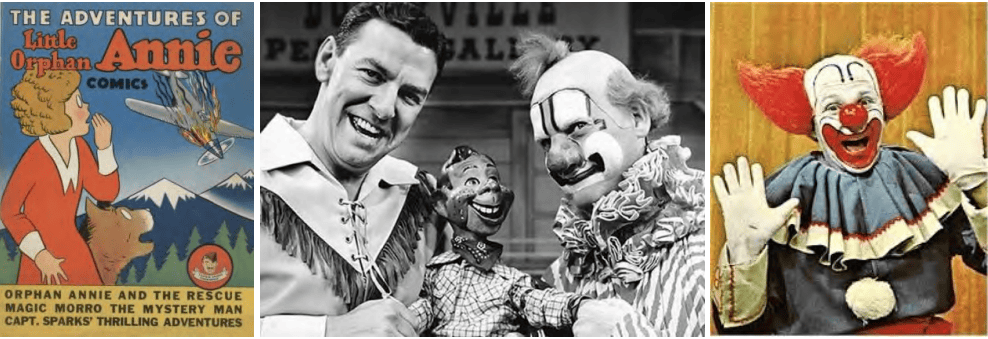
By the time television came into American homes in the late 1940s, producers had a variety of successful models for children’s programs established by radio. The pioneering 1947 TV example was a live action show broadcast nationally on NBC, featuring host Buffalo Bob Smith and a marionette named Howdy Doody. A cast of character-portraying actors and marionettes interacted with an onstage audience of children, “the Peanut Gallery.” Bob Keeshan, who performed as Clarabell the clown, went on to star as Captain Kangaroo on the longest running nationally-broadcast children’s program, adopting a similar format, from 1955 to 1984 on CBS.
Two years after the first commercial broadcast in Los Angeles, the originating station, KTLA, introduced a daily puppet show for children in 1949. Time for Beany, created by Bob Clampett, featured a noteworthy ensemble of characters including a little boy, a sea serpent, a ship’s captain and a silent filmstyle villain. It was broadcast in an after-school / before dinner time slot to capture the largest possible target audience. That year, KTLA also introduced Bozo the Clown, a character originally created by Alan W. Livingston for a children’s book and a play-along record album. For years, Bozo was performed by Pinto Colvig and then, his successors, but TV didn’t have to rely on puppeteers and live hosts alone – it had a secret weapon.
Producers could pay fees to broadcast theatrical cartoons to fill in segments of their programs. Affordable older cartoons from the great period of animation – often from defunct studios and producers – introduced children of the Baby Boom [aren’t you tired of that title?] to characters their parents had laughed with in darkened movie houses on Saturday afternoons long before: Koko the Clown, Popeye and Olive Oyl, Betty Boop and Bosco. Some shows were able to include the early products of Warner Bros.- and MGM Cartoons, with their stables of iconic characters, though Walt Disney Studios reserved their catalog for their own sortie into children’s programming and for a new concept rising out of the orange groves of Anaheim. (It may be useful to remember that the older cartoons were released in black-and-white and broadcast on TV systems using the same format. It was not until 1965 that networks began to broadcast the majority of their prime time programming in color and not until 1972 that the sale of color sets outnumbered black-and-white)
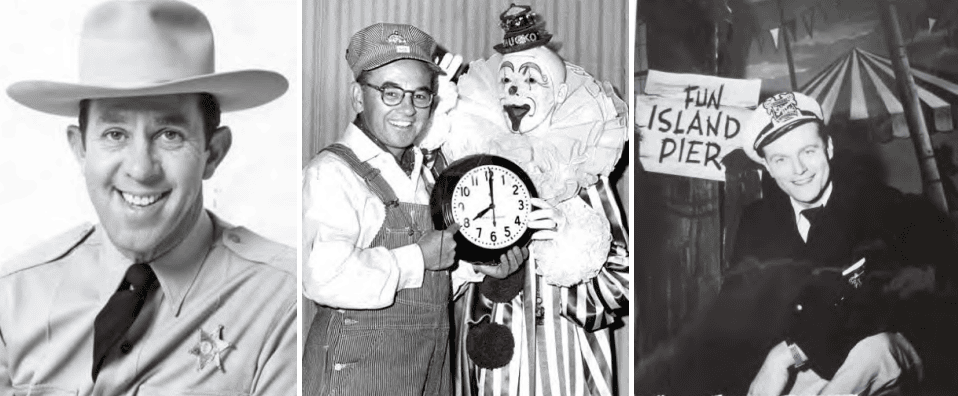
Cartoons were a hit and they became a feature of the local triumvirate of live host children’s shows that has passed into legend:
Sheriff John’s (John Rovick) Lunch Brigade / Cartoon Time from KTTV, beginning in 1952
Cartoon Express with Engineer Bill (Stulla) from KHJ, in 1955
Cartoon Carousel with Skipper Frank (Herman) from KTLA, 1956
[Honorable mention: The Pier Five Club > Popeye and Friends with “Skipper” Tom Hatten (a reinvented newscaster), KTLA, 1956].
Kids had to take a break from their after-school play to watch these programs and to stay informed about the daily happenings for discussions they would have with their friends at school on the next day. In 1952, they could tune in to The Webster Webfoot Show on KCOP, featuring ventriloquist Jimmy Weldon partnering with his “Donald”-like duck puppet in a baseball cap, or Thunderbolt the Wonder Colt, on KTLA, another Bob Clampett puppet creation featuring a clumsy nag who became endowed with superhero powers, voiced by the venerable Hollywood star, John Carradine.
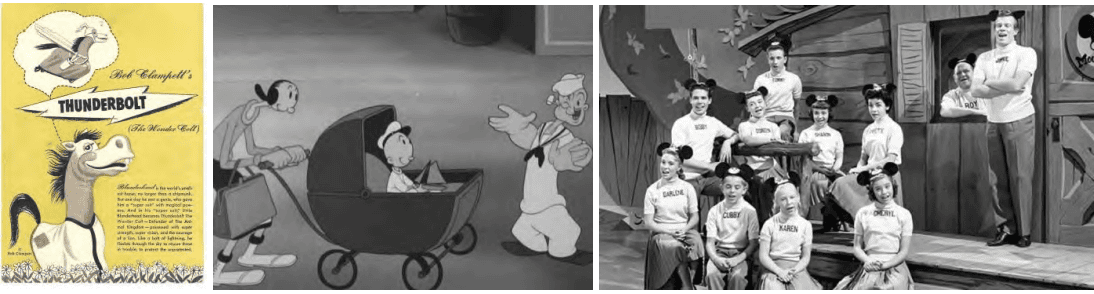
Chucko the Clown, performed by Charles Runyon, was on hand, starting in 1955 on KABC, to celebrate the birthday of a new guest each day, on air in the company of his/her friends. Former news- and weather presenter, Sally Baker, took on the personality of Hobo Kelly in 1965 to gently influence kids to good behavior. She could “see” individual home viewers through oversized glasses she donned in KTTV’s studio. With similar intentions, “Miss Mary Ann” King hosted Romper Room – sessions for preschoolers on KCOP from 1966. This show had the distinction of being a franchise concept sold to different producers across the country, who furnished their own local casts, crews and sets for each market.
Disney put the resources of their frontline studio into the production of The Mickey Mouse Club, first broadcast locally on KABC in 1955. The show featured two hosts, a bevy of teen club members, musical and dance numbers, “I/E” segments, vintage Mickey Mouse cartoons, episodes of several adventure serials and freshly-animated inserts featuring “the Mouse.” Each weekday broadcast had a set theme – in order: “Fun with Music Day,” “Guest Star Day,” “Anything Can Happen Day,” “Circus Day” and “Talent Round-Up Day.” Young viewers had to be sure to keep up with the latest goings-on in the clubhouse.
With the 1960s, many networks and stations were able to broadcast made-for-TV cartoon series at costs comparable to producing live-action shows broadcast and/or recorded in-studio. They set aside large blocks of programming time on Saturday mornings to attract children viewers and profitted from the heavy sponsorship of toymakers and breakfast cereal manufacturers. So many memorable cartoon series were created by companies like Hanna-Barbera, U.P.A. and Jay Ward Productions, it would be impossible to do them justice in the confines of this article. Please keep them in mind for another time.
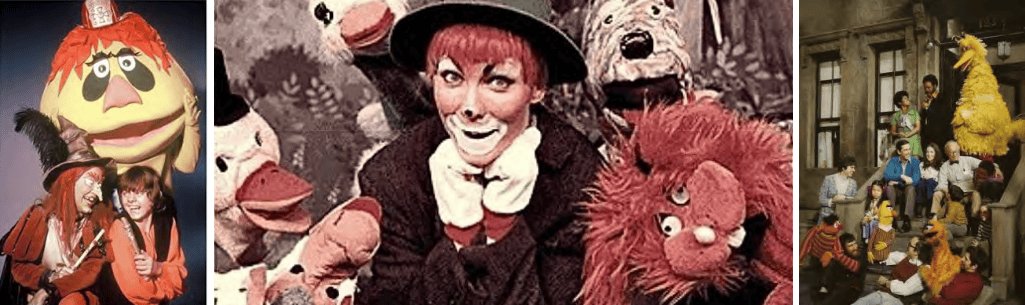
The creative team of Sid and Marty Krofft introduced a new kind of series with adult-size costume characters, H. R. Pufnstuf, on KNBC in 1969, and Stu Rosen moved from public television to KCBS as host of a group of puppet characters at Dusty’s Treehouse in 1970, where they could meet guests and take field trips. Similar elements were combined in the format of now-legendary Sesame Street, first broadcast on PBS in 1969.
With these, and many more shows for the younger audience, television became an integral part of the lives of each succeeding generation. The programs made the transition to the next forms of electronic media almost effortlessly. Our newsletter articles sometimes end with a twinge of sadness for something good from the past that has retreated into the shade of memory, but children’s media programming is too vital a part of our culture and our economy to fade away. It has simply moved with the times, transferred to the latest electronic outlets for the entertainment of kids and renewed itself.

🎵”Baby shark, doo-doo, doo-doo, doo-doo,”🎵
WHERE HAVE ALL THE DOCTORS GONE?
In 1976 there were 49 physicians practicing in Hawthorne; currently, there are now 5 doctors with independent practices in the City of Good Neighbors. Most family doctors and medical specialists are now housed in large medical complexes such as: Northeast Community Clinic at 4455 W. 117th Street. Longtime Hawthornians will probably remember this building as the Axminister Medical Group. The other clinics serving the medical needs of Hawthorne residents include the Hawthorne Health Care Medical Center located at 11633 Hawthorne Blvd, Providence Primary Care at 12618 Hawthorne Blvd, Vasek Polak Health Clinic at 13440 Hawthorne Blvd and Centro Medico at 19446 Hawthorne Blvd. These are the major medical practices that replaced the independent family practices that were mostly located in small offices dispersed along the main thoroughfares small of Hawthorne.
The transition from family physicians to large clinics, many affiliated with medical conglomerates, can be attributed to a plethora of factors. Since the 1980’s, the health care industry has moved from independent practices to large clinics in order to save money and afford more patients access to health care. Insurance companies have created corporations such as Optum to bridge physician networks and insurance companies. Many PPO’s are regulated by these corporations and bureaucrats, rather than by practicing physicians, determining what medical services insurance holders can access. This new model, combined with the ever-rising cost of medical malpractice insurance, has forced many privately practicing doctors out of business.
The doctors interviewed for this article cited reasons for relocating their practices as being closely related to Hawthorne specifically, rather than the systemic changes in the healthcare industry. Many pointed to crime and graffiti in the City as the major component in their exodus, stating their patients don’t feel safe. Also mentioned was the need for larger offices and more parking as their practices grew.
With the flight of family doctors who served all the needs of Hawthorne families, many Hawthornians nostalgically long tor the days when families shared one doctor who treated family members for everything from childbirth to senior care. Obviously, the relationship between them and their family doctor was closer and more inclusive than a relationship between a healthcare provider in a large medical clinic and their patients. Many of the beloved family doctors actually made house calls. Growing up, it was not unusual for the family doctor to give Hawthorne children their vaccinations, surgically remove tonsils and appendix and perform camp and sports physicals. Family doctors knew the medical needs of a family and had a keen understanding of their patients’ medical history.
The relationships between physicians and the families they served created friendships that often lasted generations. Certainly, these relationships heavily contributed to the community atmosphere enjoyed by Hawthorne families for so many years.
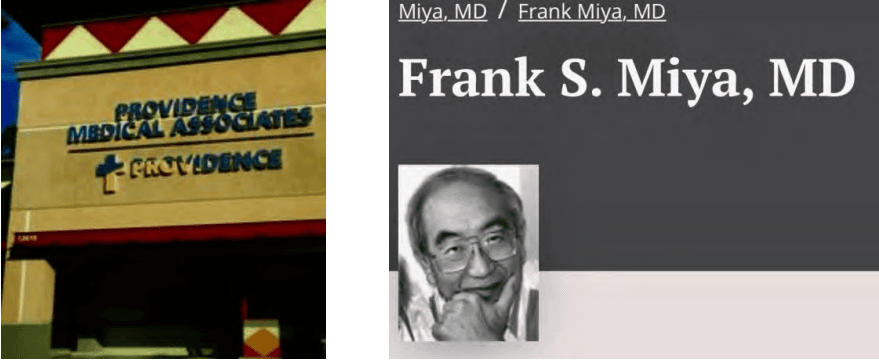
Dr. Frank Miya practiced medicine in Hawthorne for over fifty years. His small office on Inglewood Avenue was continually bustling with activity. His office filled with patients ranging from infants with ear infections to expectant mothers ready for delivery. His calm manner and caring nature endeared him to many community residents for decades. Dr. Miya passed away in 2010. Dr. Khan took over the practice and is currently housed in the original Inglewood Avenue office.
Dr. Leonard Stoll provided family health services to community members from 1964 until 1986 when, along with his son Seymour, they moved their practice to Torrance. The senior Dr. Stoll was a favorite among Hawthornians, especially the school aged kids. Dr. Stoll was the doctor to go to for camp and sports physicals. He often expanded office hours to ensure the children in the community could attend camp. Once kids were at camp, he ordered enough impetigo medicine to treat all the cases he knew he would see upon campers’ return. He had a keen insight into the community at large and his patients. It was not unusual for him to end his sports physicals by giving advice on how to throw a better curve ball or run a faster mile. His son joined the practice in 1982 and continued the legacy of family practice. Dr. Leonard Stoll passed away in 2013; his son continues the practice in Torrance.
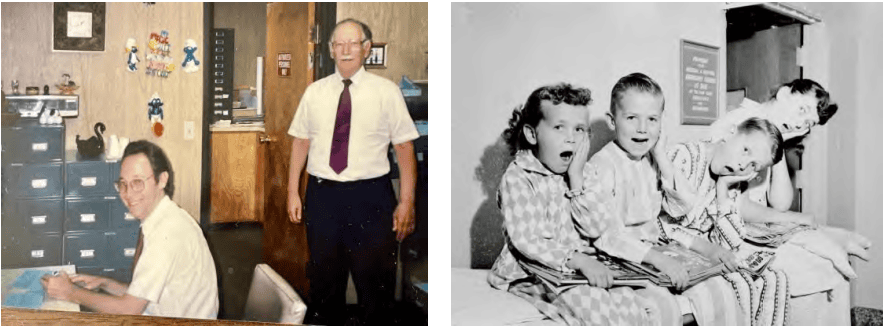
Other family physicians who were highly respected include; Dr. Bruce Barton who was known for making house calls, Dr. Hardy who helped bring hundreds of babies into the Hawthorne community and Dr. Spiere who had, for many years, the largest family practice in Hawthorne.
Unfortunately, the current structure of medicine has replaced the family doctor with a myriad of specialists and clinics and the close relationship between families and their doctors is a dim yet fond memory.
HAWTHORNE HOSPITALS – NOT ANYMORE!
Hawthorne Community Hospital/RFK
Hawthorne Community Hospital opened as a maternity hospital in 1926 as both the city and region were experiencing rapid growth, due in no small part as an extension of the greater-Los Angeles area’s population boom during the 1920s and 1930s. On January 10, 1954, the hospital was awarded $550,000 ($6,218,210.04 in 2023) from the University of Southern California as part of a grant to expand the school’s medical program. Numerous services continued to expand through the hospital, given its size and location adjacent to Hawthorne Boulevard, with the facility receiving its first expansion in 1970. In November, 1984, the hospital was renamed as Robert F Kennedy Medical Center in honor of former Senator Robert F. Kennedy, who was assassinated in Los Angeles on June 6, 1968
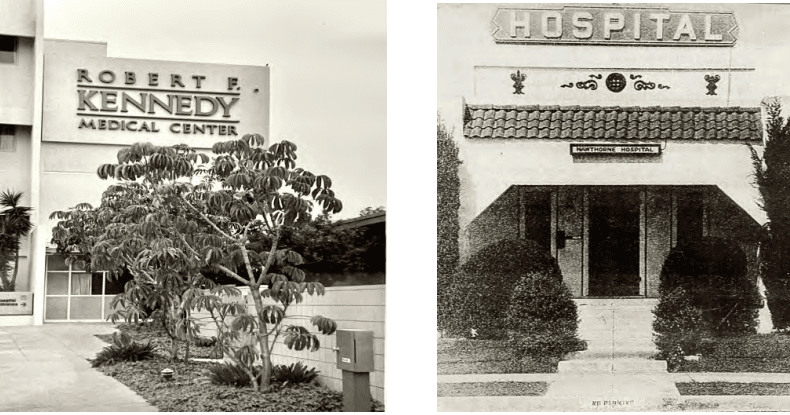
RFK hospital ceased maternity services in 1991, only to resume such services in 2001. In an effort to modernize the facility to meet local demand, Catholic West allocated funding to renovate the hospital in two phases – the first in 1996 and the second in 1999. Despite the new expansions to the facility, the hospital fell victim to the decline of the local area as a majority of patients treated were either underinsured or uninsured. The hospital also forged numerous affiliations with several nonprofit foundations within the region in an effort to allocate further funds for another expansion planned for 2001.
The plan to expand and modernize the facility in 2001 never came to fruition due to lack of funding. Citing a 77-million-dollar deficit, the hospital closed on December 31, 2004, never to re-open. RFK was the last hospital to operate in Hawthorne. Afterward, it was necessary for residents to go to neighboring cities in the South Bay.
As of 2023, the current property owners have fenced off numerous entrances to the hospital and have begun demolishing smaller structures in the parking lot. Security regularly patrols the property and motion sensors were also installed outside of the former entrances. The remains of the hospital still stand, albeit, in a state of disrepair.
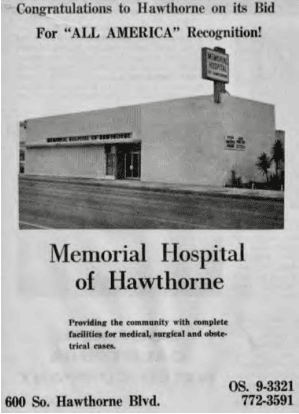
Hawthorne Memorial Hospital opened in 1964 as a community hospital serving Hawthorne’s growing population. Located at 13300 Hawthorne Blvd., the hospital was one of the smallest in the area with only 73 beds. The hospital, whose occupancy rate fluctuated between 14% and 30%, did not have an emergency room or pediatric and obstetric departments.
Consequently, the hospital was unable to compete with larger hospitals in the area such as Robert F. Kennedy Medical Center, also in Hawthorne, or Little Company of Mary Hospital in Torrance. The hospital closed in April of 1997, never to return. Currently, the closed hospital houses a psychiatric facility treating both in patients and outpatients.