


“Dark Stories”
When all the light had gone from the sky, our ancestors gathered in the caves or beneath the heavy, overhanging rock, the fires were lit, the meal shared, the families clustered in their spots, the little ones slept at their mothers’ breasts, the old ones struggled to find a comfortable position in the piled grass and leaves and all the others let the weariness begin to enter their limbs and heads. It was then that the Storyteller raised his voice. He started to fashion the long tale that would aid wakefulness through the coming hours of darkness for those who must keep watch for the group.
He brought to life again characters who seemed familiar, who resembled members of the clan. He invented dangers and exploits for them and laughable situations to relieve the tension. Skillfully, he held the attention of his listeners as he stretched out the story like the elder women of the clan who wove fibers into great lengths of cord. His stories seemed real, as though they might have happened in the day that had just passed away and yet, they often contained a whisper, a sensation of discomfort that arose from their natural fear of the unknown, the unseen that always prowled the darkness just beyond the reach of the dying fire’s light.

Sleep captured most of the listeners before the tale was told out and the Storyteller’s voice at last fell silent. The last few made their preparations to slumber, the watcher added a few twigs to the fire and the dreamlife replaced the activity of the dwelling place.
Far ahead, the dawn would rouse the first of the clan; the tasks of living would begin again. After a long, full day, there would be another gathering and then, a time for imagination to speak through the Storyteller’s voice.
Storytelling is mankind’s oldest, most essential, most elaborated form of diversion – many of our entertainments grew from the root of stories spoken in darkened caverns. The tale-tellers had long since discovered that a little scare, a little thrill of fear added appeal to their creations and they made stories with a dark side part of their repertoire. Whether the tellers used their stories to entertain or to manipulate, a tiny element of fear gave them impact. Down through the ages, they kept this tool in their toolbag.
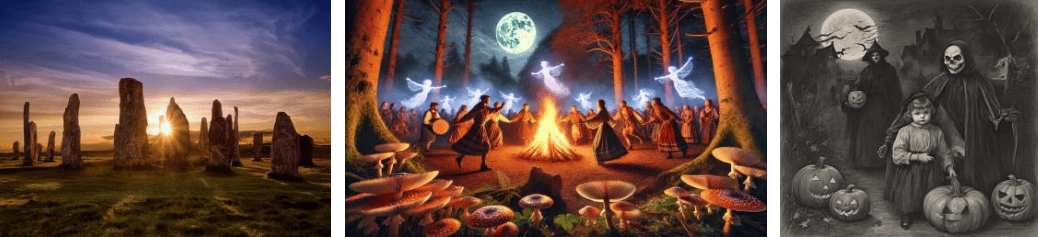
By a curious path, the tradition of certain rites and observances in the month-or-so after the autumnal equinox was brought to the shores of our Continent and made a part of American culture. In ancestral times, the equinox was a signal to the Celts of Ireland, Scotland, Wales, northern England and northern France to make the harvests, to prepare and store the crops. They feasted on October 31st to mark its completion, a festival they called “Samhain.” That day, they believed, was the cosmic division between summer and winter, a day and night when the spirits of the dead broke free from the netherworld and roamed among the living. They made bonfires, wore frightening costumes and lit their way with candles in hollowedout turnips to ward off any malevolent shades. They left out “soul cakes” to appease the wandering spirits or they went from home to home, asking for “cakes” on behalf of the departed. The brave fathers who brought the Celts to the Church could not manage to stamp out this powerful pagan tradition, so they cleverly incorporated it into a schedule of holy observance:
November 1st was a day celebrating All the Saints, the Hallowed members of the Church;
November 2nd became the celebration of All the Souls who were faithfully departed and were awaiting purification before admission to Heaven; October 31st became the evening vigil to watch for the arrival of the Day of the Hallowed – (All) Hallow(‘s) e(v)en(ing) – “Halloween” {I bet you knew that}. And, the fathers probably turned a blind eye if a little revelry the night before brought sober and repentant parishioners to the morning Mass.
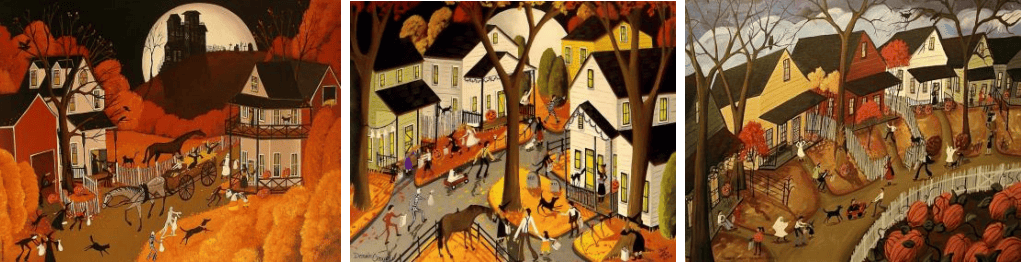
While these traditions were anathema to the principles of the Puritans who first settled New England, migrants of Celtic ancestry, especially Scottish and Irish, brought them along to the lands on the Eastern Seaboard in the 19th century, where they hoped to make their fortunes. The newcomers added an American spin and made Trick-or-treating, Jack-o’-lanterns carved from pumpkins and the commission of mischievous pranks part of the Halloween tradition. These people were also renowned for their storytelling abilities, and no season was better suited to dark tales than this time of ghosts, malevolence and dread.
Nathaniel Hawthorne was literally born to become a teller of dark stories in Salem, MA, in 1804. Salem was established by Puritans in 1626 as a fisherman’s station, and it prospered until the Witch Trials in 1692. In the aftermath, the village declined as knowledge of the mass hysteria, persecution, and hangings committed by its citizens spread to a wider world. The seamen, shipwrights and shipowners brought the seaport back to prominence, but they had also made Salem one of the first places in America where captured Africans were landed as slaves. When Nathaniel was born, Salem and its prosperous citizens were again in decline, eclipsed by Boston and other growing ports on the Atlantic coast.
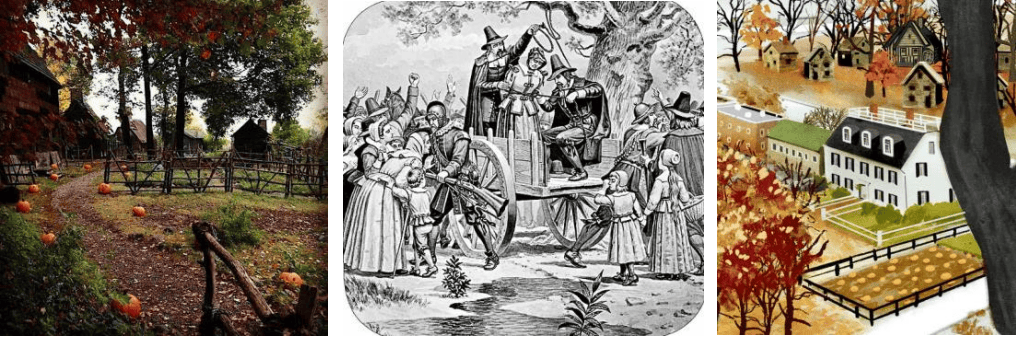
The Hathorne family had lost its position in local society by the time Capt. Nathaniel Hathorne died of yellow fever in Surinam, leaving his widow, two daughters and 4-year-old Nathaniel in meagre circumstances. (Nathaniel Jr. added the “w” to his surname when he was a young man, presumably to disguise his descent from great-great-grandfather, John Hathorne, the “Hanging Judge” of the witchcraft trials) They moved in with his mother’s family, the Mannings, where they
are said to have pursued an isolated, pious, scanty life. The Manning uncles built a farmhouse for the Hathorne family in rural Maine, where introverted, 12-year-old Nathaniel lived happily until he returned to Salem at 15 to continue his education. His uncles enrolled him in Bowdoin College (Brunswick, ME) when he was 17, from where he managed to graduate in 1825, but took little interest in his studies, preferring to pursue his own fancies, while making only a couple of
friends.
Determined to become a writer, young Hawthorne moved back to the Manning house in Salem and sequestered himself in a fourth-floor attic garret. He read hundreds of books borrowed from Salem’s pioneering library, did clerical work for his uncles’ business, maintained a distant relationship with his housemate sisters and laboured for twelve years to develop artistry in writing. He concentrated his interest on the short story, a genre little practised in the United States at the time. In 1828, he self-published a novel titled Fanshawe to such regret that he asked for the copies to be returned to him so that he could destroy them.
With only a few pieces printed in obscure magazines, he despaired of achieving his dream. He first came to public notice in 1837, when Twice-Told Tales, a collection of short stories was published. (College friend and successful naval officer, Horatio Bridge, had secretly offered to cover the publisher’s losses, if necessary) It brought him to the attention of Elizabeth Peabody, a woman in tune with the current social movements, and his future sister-in-law. Elizabeth was an abolitionist and a Transcendentalist who had relocated her merely-subsisting family from Salem to Boston, where she opened a popular book shop that became the de facto centre of the Transcendental movement. Through her, Hawthorne was introduced to the principal leaders of intellectual life in the Commonwealth of the time, though he did not embrace the popular movements. He was also introduced to her pretty, artistic, frail sister, Sophia. Nathaniel was smitten. He was appointed to a position at the Boston Customs House in 1838, allowing him to gradually save the means necessary to support Sophia, who accepted his proposal in 1842. They moved to the Old Manse in Concord and spent a few happy years, but Hawthorne’s continued writing won him little recognition. He obtained a post at the Salem customs house, only to lose it in a political reversal.
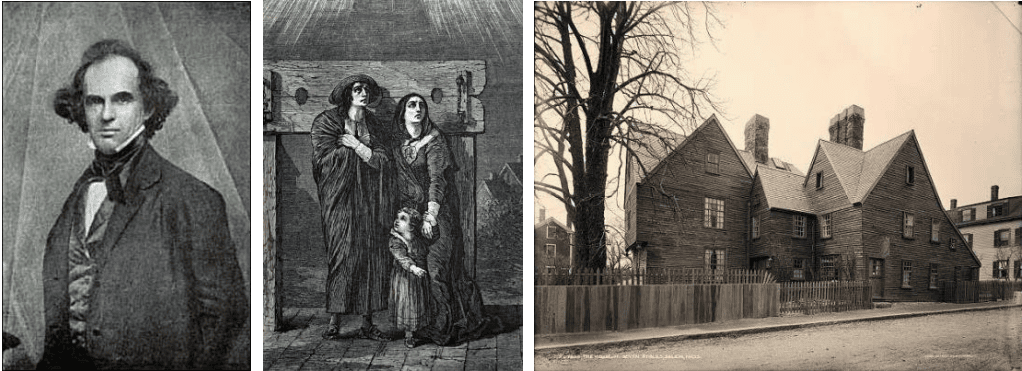
In 1849, he began writing The Scarlet Letter and published it in the spring of 1850, to immediate popularity. The success allowed him to abandon Salem and its gloomy memories. He followed in 1851 with The House of the Seven Gables and in 1852 with The Blithedale Romance, both wellreceived. In 1853, former college friend, now President Franklin Pierce, appointed him to the Consulate in Liverpool, England and he began a long-desired European sojourn of seven years. He published The Marble Faun on his homecoming to Massachusetts in 1860. Two years later, sudden decline foretold the end of Hawthorne’s life. He died in 1864 and is at rest in Sleepy Hollow Cemetery, Concord, MA.
While Hawthorne sought to examine the vulnerability and weakness of the human character, particularly when faced with hardship, the dark elements of his own life colored the settings of the stories he created: witchcraft, grim old houses, sudden deaths, hauntings, supernatural influences and malevolence invaded the background of his tales. Hester Prynne, protagonist of The Scarlet Letter, is sent ahead alone to the new Puritan colony of Boston by her uncaring older husband. She soon believes that her husband has died in a shipwreck and surrenders to the kindness and protection of ardent young minister, Arthur
Dimmesdale. In his love for her, he succumbs to desire and fathers a daughter, Pearl. Hester swears never to reveal their union and submits to public humiliation and ostracism when her pregnancy is discovered. Among the observers is Prynne, now deformed and barely recognizable. He later approaches Hester, condemns her and demands she reveal her lover’s identity. She refuses. As Pearl grows, Hester lives a modest and charitable life, bravely bearing the badge of adultery – the letter ‘A’ – on her garments. Dimmesdale is tortured by guilt and suffers physical decline. Prynne, posing as a doctor Chillingworth, becomes Dimmesdale’s caregiver and companion in an attempt to confirm what he suspects – that Dimmesdale is Pearl’s father. Hester and Dimmesdale realize his intent and plan to flee to England. Before they can sail, they learn that Prynne has booked passage with them. Dimmesdale delivers his most eloquent sermon and outside the church, mounts the scaffold where Hester was humiliated. He confesses his love and his sin to the assembled and admits he is Pearl’s father. He falls dead with the effort. Prynne, too, dies within the year. Hester and Pearl remove to England, but long afterward, at her death, she is buried at Dimmesdale’s side, a scarlet letter ‘A’ carved into their shared tombstone. Dark enough for a story fitting the Halloween season.
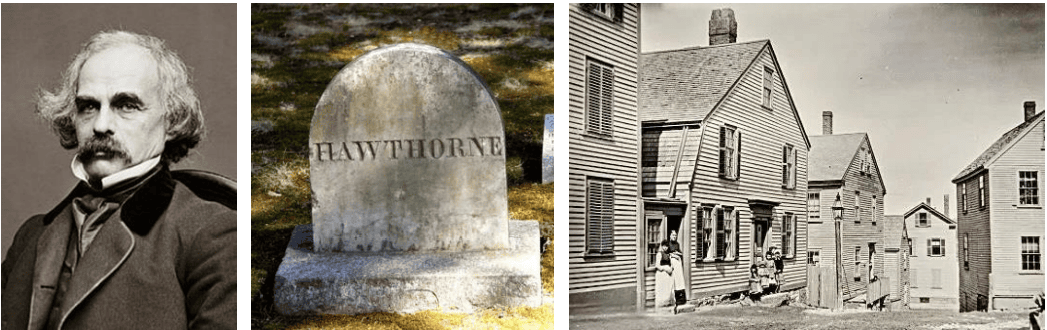
Hawthorne was finally recognized as the foremost man of letters of his time by his nearcontemporaries, like poet Henry Wadsworth Longfellow and author Ralph Waldo Emerson. He inspired Herman Melville and Edgar Allan Poe.
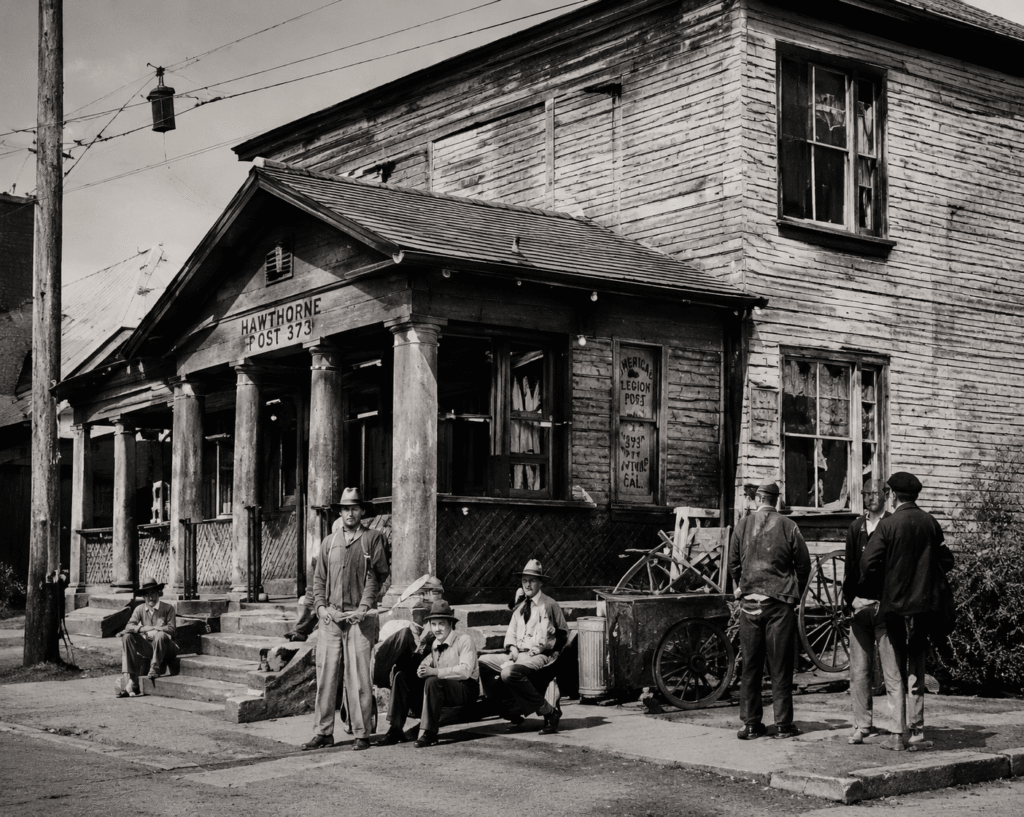
When, at last, the ruins of the Hawthorne Plaza are cleared away from the birthplace of our City, could not a new monument be raised, a “House of the Seven Gables,” to reaffirm our gratitude to an exceptional American storyteller who lent his name and his legacy to guide us in our labors?